
The Executive Summary of
WOHA: New Forms of Sustainable Architecture
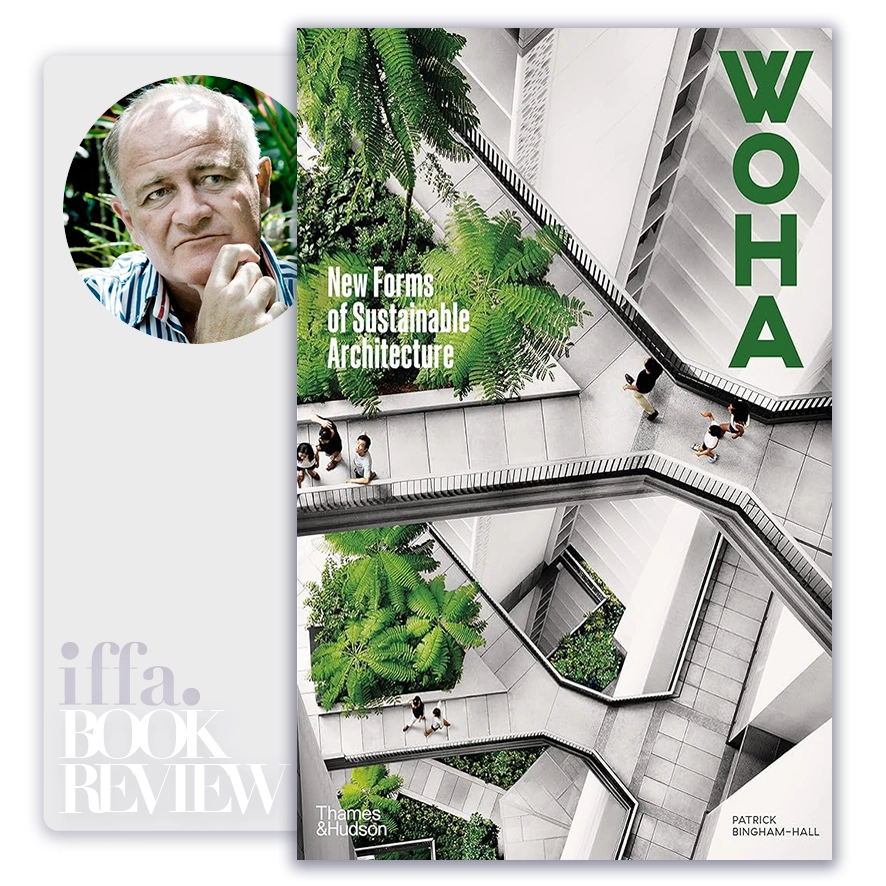
by Patrick Bingham-Hall
Summary Overview:
WOHA: New Forms of Sustainable Architecture matters because it challenges one of the most persistent assumptions in contemporary development: that dense urban growth must come at the expense of environmental quality and human well-being. At a time when cities—especially in Asia and the Global South—are expanding vertically and rapidly, the work of WOHA offers a compelling alternative to energy-intensive, sealed-glass urbanism.
This book is especially relevant as climate change, urban heat, biodiversity loss, and resource scarcity converge in cities. Conventional “green” solutions often rely on mechanical systems, certifications, or symbolic gestures layered onto fundamentally unsustainable building types. By contrast, WOHA’s projects—documented and analyzed by Patrick Bingham-Hall—demonstrate how architecture itself can function as environmental infrastructure, shaping microclimate, ecology, and social life through form, section, and landscape integration.
For leaders, planners, developers, and sustainability-focused institutions, the book reframes sustainable architecture as a structural and spatial strategy, not a technological add-on. It shows that long-term urban resilience depends on rethinking how buildings relate to climate, density, and nature—particularly in hot, humid, and resource-constrained contexts.
About The Author
Patrick Bingham-Hall is an architecture writer and editor with deep experience documenting and interpreting contemporary architectural practice in Asia. His perspective is distinctive for combining critical analysis with close observation of built work, making complex design ideas legible without diluting their rigor.
Core Idea:
The core idea of WOHA: New Forms of Sustainable Architecture is that sustainability in dense cities must be spatial, climatic, and ecological by design, not reliant on energy-heavy systems or imported models. WOHA’s architecture treats buildings as three-dimensional landscapes—stacking greenery, airflow, water, and social space vertically to restore environmental functions typically lost in urbanization.
Bingham-Hall presents WOHA’s work as a response to the realities of tropical urbanism. Rather than imitating Western modernist forms, WOHA develops an architecture rooted in climate logic: natural ventilation, shading, evapotranspiration, and porous massing. Sustainability here is not a constraint, but a generative force that shapes form, experience, and identity.
True urban sustainability is achieved when buildings replace the environmental functions they displace.
Key Concepts:
- Architecture as Environmental Infrastructure
WOHA’s buildings perform ecological roles—cooling air, absorbing rainwater, supporting vegetation, and creating habitats. This reframes architecture from object-making to system-building within the urban ecosystem. - High-Density, High-Amenity Urbanism
The book shows how density can coexist with generosity. Sky gardens, terraces, and open-air circulation replace sealed corridors and lobbies, creating breathable, humane high-rise environments. - Climate-Responsive Form
Building massing, orientation, and section are designed to maximize airflow and shading. Sustainability emerges from geometry and layout rather than mechanical compensation. - Vertical Greenery as Functional System
Vegetation is not decorative. It reduces heat gain, improves air quality, manages stormwater, and supports biodiversity. Green space is distributed throughout the building, not confined to ground level. - Passive Design Over Active Systems
WOHA prioritizes passive cooling, daylighting, and ventilation. Mechanical systems are minimized, reducing energy demand, maintenance complexity, and operational risk. - Social Sustainability Through Space
Shared terraces, communal gardens, and visible circulation encourage interaction and community. The book highlights how spatial design supports social cohesion in dense environments. - Tropical Modernism Reimagined
WOHA’s work continues and evolves the tradition of tropical modernism, adapting it to contemporary scale and complexity. The result is a regionally grounded yet globally relevant architectural language. - Integration of Landscape and Building
Landscape is treated as structure, not leftover space. Buildings become extensions of the ground plane, stacked vertically to compensate for land scarcity. - Performance Beyond Metrics
While energy and environmental performance matter, the book emphasizes lived experience—thermal comfort, sensory richness, and psychological well-being—as core sustainability outcomes. - Replicability and Urban Impact
WOHA’s projects are not isolated experiments. They propose a repeatable model for sustainable high-density development applicable to rapidly urbanizing regions worldwide.
Density and nature are not opposites when architecture is designed as climate-responsive infrastructure.
Executive Insights:
WOHA: New Forms of Sustainable Architecture reframes sustainability as a design-led, place-specific response to urban growth, not a universal checklist. Its insights suggest that many cities are pursuing density with the wrong architectural tools—importing sealed, energy-intensive models unsuited to local climate.
For decision-makers, the book highlights that environmental performance, livability, and identity can be aligned when sustainability is embedded at the architectural level. Buildings that reduce heat, energy demand, and social isolation simultaneously create long-term economic and environmental value.
The book also carries a strategic warning: reliance on mechanical systems and certifications alone increases vulnerability to energy shocks, maintenance failure, and climate extremes. Architecture that works with climate is inherently more resilient.
Key strategic implications include:
- Dense cities require climate-responsive architecture, not sealed typologies
- Sustainability is most effective when embedded in form and section
- Green space must be vertical as well as horizontal
- Passive design reduces long-term operational risk
- Architecture can restore ecological function within urban density
Actionable Takeaways:
The book offers clear principles for sustainable urban development and design leadership.
- Treat buildings as environmental systems, not isolated objects
- Embed climate response into massing, orientation, and section
- Distribute greenery vertically to replace lost ground-level ecology
- Prioritize passive cooling and ventilation over mechanical dependence
- Design shared spaces that support social life in dense settings
- Evaluate sustainability through lived comfort as well as metrics
- Adapt architectural models to local climate rather than importing typologies
Final Thoughts:
WOHA: New Forms of Sustainable Architecture is a persuasive demonstration that the future of cities does not lie in technological escalation, but in architectural intelligence grounded in climate, ecology, and human experience. Through Patrick Bingham-Hall’s lens, WOHA emerges not just as a practice, but as a model for rethinking urban density itself.
The enduring insight of the book is clear: sustainable cities are built when architecture restores what urbanization removes—air, greenery, water, and social space. Leaders and designers who embrace this approach will be better equipped to shape cities that are not only dense and efficient, but resilient, humane, and truly alive.
The ideas in this book go beyond theory, offering practical insights that shape real careers, leadership paths, and professional decisions. At IFFA, these principles are translated into executive courses, professional certifications, and curated learning events aligned with today’s industries and tomorrow’s demands. Discover more in our Courses.
Applied Programs

- Course Code : SBM-409
- Delivery : In-class / Virtual / Workshop
- Duration : 2-4 Days
- Venue: DUBAI HUB
- Course Code : PMA-613
- Delivery : In-class / Virtual / Workshop
- Duration : 3-5 Days
- Venue: DUBAI HUB

- Course Code : CIF-505
- Delivery : In-class / Virtual / Workshop
- Duration : 3-5 Days
- Venue: DUBAI HUB

- Course Code : CIF-512
- Delivery : In-class / Virtual / Workshop
- Duration : 2-4 Days
- Venue: DUBAI HUB
Related Books