

The Executive Summary of
Modern Architecture & Climate
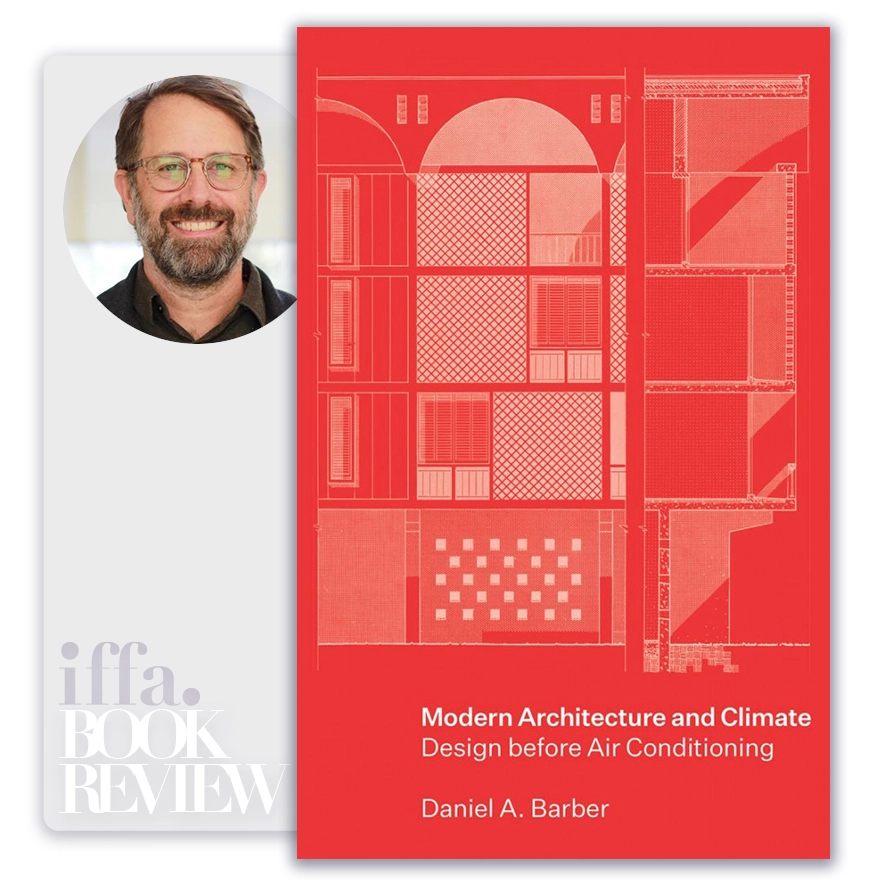
by Daniel A. Barber
Summary Overview:
Modern Architecture & Climate reframes modern architecture through a lens that is both timely and unsettling: climate has never been peripheral to modern design—it has been central to it. Long before sustainability became a policy mandate or marketing term, architects were already negotiating heat, light, energy, comfort, and environmental control. What changed over time was not awareness of climate, but the belief that technology could master it without consequence.
Daniel A. Barber reveals how modern architecture’s optimism—glass façades, mechanical conditioning, universal forms—embedded assumptions about energy abundance, environmental control, and progress that continue to shape today’s buildings and cities. For executives, architects, developers, and policymakers navigating decarbonization, retrofit challenges, and climate accountability, this historical perspective is crucial. The book shows that today’s climate challenges are not design failures in isolation, but the cumulative result of long-term architectural choices, cultural narratives, and governance priorities. By understanding how climate thinking was absorbed, redirected, and sometimes obscured within modernism, leaders gain sharper judgment about what must change now—and what patterns must not be repeated under the banner of innovation.
About The Author
Daniel A. Barber is an architectural historian and scholar specializing in the intersection of modern architecture, technology, and environmental thought. His work is distinctive for connecting design history with climate discourse, revealing how cultural narratives and technical choices co-evolve.
Core Idea:
The core idea of Modern Architecture & Climate is that modern architecture has always been entangled with climate, energy systems, and environmental imagination, even when it claimed universality or neutrality. Climate was not ignored—it was often reframed through technology, abstraction, and mechanical control.
Barber argues that modernism’s promise of environmental mastery—through glass façades, mechanical conditioning, and standardized forms—created both innovation and dependency. These choices solved immediate comfort challenges while externalizing long-term environmental costs. The book does not condemn modernism; it contextualizes it, showing how architectural responses to climate were shaped by cultural optimism, industrial power, and political economy.
Modern architecture did not ignore climate—it sought to control it.
Key Concepts:
- Climate as a Design Problem, Not a Background Condition
Barber shows that early modern architects treated climate as something to be engineered rather than accommodated. This matters at an executive level because it reveals a persistent mindset: design decisions embed assumptions about energy abundance and control.
- Buildings were conceived as closed systems
- Comfort was mechanized
- Environmental limits were deferred
Book example: The rise of mechanically conditioned buildings reframed climate from context to obstacle—an assumption still embedded in many commercial developments.
- Universal Form vs. Local Climate
Modernism pursued universal architectural language—glass, concrete, steel—often at the expense of regional climate specificity. Strategically, this highlights the risk of scaling solutions without contextual intelligence.
- Universal form promised efficiency
- Local climate complexity was minimized
- Replication replaced adaptation
Book example: International Style buildings replicated across climates, relying on energy systems to compensate for mismatch.
- Technology as Environmental Mediator
Barber emphasizes that technology became the bridge between architecture and climate. While enabling innovation, it also created systemic energy dependency.
- Mechanical systems replaced passive strategies
- Short-term comfort trumped long-term cost
- Energy invisibility reduced accountability
Executive relevance: Leaders today face similar trade-offs when relying on smart systems without addressing underlying design logic.
- Glass Architecture and the Climate Paradox
The modern glass façade symbolized transparency and progress, yet intensified thermal gain and loss. This contradiction illustrates how symbolic design choices can conflict with environmental performance.
- Aesthetic ideals drove form
- Energy penalties were accepted
- Performance was outsourced to systems
Book example: Curtain-wall skyscrapers that require constant cooling and heating despite technological sophistication.
- Climate Knowledge as Cultural Narrative
Barber shows that climate data alone did not drive design decisions—cultural beliefs about progress, comfort, and control did. This matters for governance: facts rarely change systems without narrative alignment.
- Data competes with ideology
- Design reflects belief systems
- Cultural framing shapes adoption
Leadership insight: Sustainability strategies fail when they ignore cultural narratives within organizations.
- Environmental Control and Power
Modern architecture’s promise of climate control aligned with political and economic power structures. Buildings became symbols of dominance over nature.
- Control equated to progress
- Scale signaled authority
- Energy cost was externalized
Strategic implication: Mega-projects today risk repeating this logic if power signaling outweighs environmental judgment.
- The Separation of Design and Environment
Barber highlights how professional specialization separated architects from environmental responsibility, delegating performance to engineers.
- Fragmentation reduced accountability
- Design intent and performance diverged
- Responsibility became diffused
Executive relevance: Integrated governance models outperform siloed decision-making in complex systems.
- Climate Awareness Before “Sustainability”
The book reveals that climate-responsive ideas existed long before sustainability became mainstream—but were often sidelined.
- Passive design was known
- Political economy favored energy use
- Alternatives lacked institutional support
Book example: Early experiments in climate-adaptive housing that were overshadowed by industrialized building models.
- Modernism’s Legacy in Today’s Climate Crisis
Barber does not blame modernism but shows how its assumptions shaped today’s building stock and emissions profile.
- Long-lived assets lock in behavior
- Retrofitting is harder than redesign
- Past decisions constrain future options
Strategic lesson: Long-term assets require long-term environmental judgment at inception.
- Rethinking Progress Through Climate Intelligence
The book ultimately calls for a new definition of progress—one that integrates climate intelligence into design ambition.
- Performance over symbolism
- Adaptation over universality
- Responsibility over spectacle
Executive takeaway: Leadership today requires redefining success metrics beyond speed, scale, and visual impact.
Today’s climate challenges are inseparable from yesterday’s architectural assumptions.
Executive Insights:
Modern Architecture & Climate reframes sustainability as a historical and strategic continuity, not a correction imposed from outside. Its central insight is that climate performance is shaped less by technology availability and more by design values, governance structures, and cultural narratives.
For executives, developers, and policymakers, the book highlights a critical risk: repeating modernism’s mistakes under the banner of innovation. Smart buildings, AI-driven systems, and green certifications can reproduce the same dependency patterns if environmental responsibility is deferred rather than embedded.
The book also underscores that architecture is a long-term climate actor. Buildings outlast policies, leaders, and technologies. Decisions made today will define energy use and emissions for decades.
Actionable Takeaways:
The book offers principle-driven guidance for leaders shaping the built environment.
- Treat climate as a core design driver, not a constraint
- Question universal solutions applied across contexts
- Align technology with passive and contextual strategies
- Integrate design, engineering, and governance accountability
- Evaluate long-term environmental lock-in before scaling
- Redefine architectural success beyond symbolism
- Embed climate intelligence into leadership judgment
Final Thoughts:
Modern Architecture & Climate is ultimately a book about responsibility over time. Daniel A. Barber shows that architecture has always been climate-active—either by design or by consequence. The question facing leaders today is not whether architecture affects climate, but whether we acknowledge that influence early enough to act wisely.
The enduring insight of the book is clear and demanding: climate-conscious leadership in architecture requires not better technology alone, but better judgment about what we choose to build, repeat, and celebrate. Those who understand this history gain not only perspective—but the strategic clarity needed to shape a more resilient future.
The ideas in this book go beyond theory, offering practical insights that shape real careers, leadership paths, and professional decisions. At IFFA, these principles are translated into executive courses, professional certifications, and curated learning events aligned with today’s industries and tomorrow’s demands. Discover more in our Courses.
Applied Programs

- Course Code : SBM-409
- Delivery : In-class / Virtual / Workshop
- Duration : 2-4 Days
- Venue: DUBAI HUB
- Course Code : PMA-613
- Delivery : In-class / Virtual / Workshop
- Duration : 3-5 Days
- Venue: DUBAI HUB

- Course Code : CIF-505
- Delivery : In-class / Virtual / Workshop
- Duration : 3-5 Days
- Venue: DUBAI HUB

- Course Code : CIF-512
- Delivery : In-class / Virtual / Workshop
- Duration : 2-4 Days
- Venue: DUBAI HUB
Related Books