
The Executive Summary of
Biomimicry in Architecture
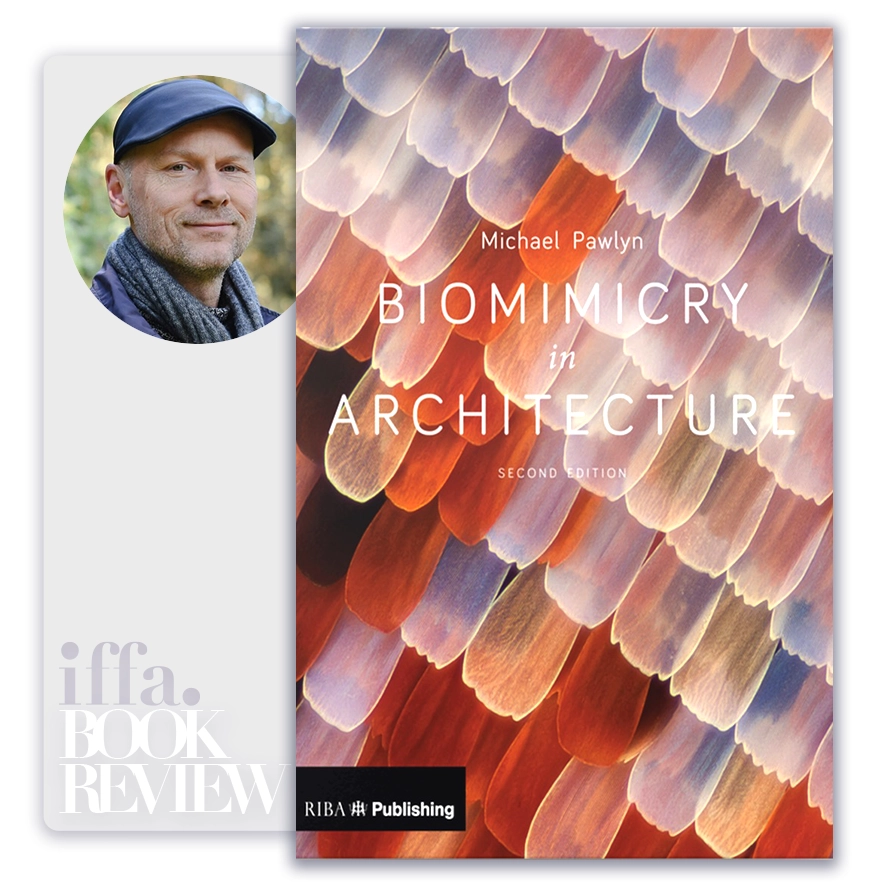
by Michael Pawlyn
Summary Overview:
Biomimicry in Architecture reframes sustainability not as a constraint on design ambition, but as an expansion of what architecture and engineering can achieve. Michael Pawlyn argues that nature—refined through billions of years of evolution—offers tested strategies for efficiency, resilience, and integration that far exceed many modern industrial solutions. The book matters because it shifts the sustainability conversation from incremental improvement to fundamental redesign of how buildings work.
Pawlyn demonstrates that biomimetic thinking can reduce material use, energy demand, and operational risk simultaneously, offering performance gains that align with long-horizon value creation rather than short-term compliance.
About The Author
Michael Pawlyn is an architect and thought leader known for advancing biomimicry and regenerative design within the built environment. He has worked on pioneering projects that apply biological principles to architecture, engineering, and urban systems.
His perspective is distinctive because it bridges biological insight with architectural and engineering feasibility, translating natural strategies into concepts that can be built, scaled, and governed in real-world projects.
Core Idea:
The central thesis of Biomimicry in Architecture is that nature should be treated as a design mentor rather than a resource to be exploited. Pawlyn argues that many of the challenges facing the built environment—energy efficiency, material optimization, climate control, and resilience—have already been solved elegantly in natural systems.
At a deeper level, the book presents a worldview in which architecture becomes a participant in ecological systems rather than an imposition upon them. By studying how organisms manage energy, structure, water, and waste, designers can create buildings that achieve more with less—reducing dependency on mechanical intervention while increasing performance and adaptability.
Nature offers a library of solutions refined by survival, not speculation.
Key Concepts:
- Nature as Mentor, Not Model
Biomimicry is about principles, not imitation.
- Abstract strategies outperform literal copying.
- Insight matters more than appearance.
- Efficiency Through Form
Natural geometries minimize material and energy.
- Structure and performance are inseparable.
- Shape reduces resource demand.
- Passive Environmental Control
Organisms regulate temperature without machinery.
- Ventilation, shading, and thermal regulation are embedded.
- Energy demand declines structurally.
- Multifunctional Design
Nature avoids single-purpose elements.
- Components perform multiple roles.
- Integration replaces redundancy.
- Closed-Loop Thinking
Waste does not exist in ecosystems.
- Outputs become inputs.
- Circularity reduces dependency.
- Adaptability and Responsiveness
Natural systems respond dynamically.
- Buildings should adjust to conditions.
- Static optimization creates fragility.
- Material Intelligence
Nature builds with minimal resources.
- Strength emerges from arrangement, not mass.
- Lightweight solutions outperform heavy ones.
- Water as a Design Driver
Hydrological strategies shape ecosystems.
- Collection, storage, and filtration are integrated.
- Infrastructure becomes landscape.
- Resilience Through Diversity
Monocultures fail under stress.
- Variety enhances system stability.
- Redundancy supports continuity.
- Design as Systems Thinking
Biomimicry demands holistic integration.
- Isolated features miss potential.
- Whole-system thinking unlocks performance.
True sustainability emerges when buildings function more like ecosystems than machines.
Executive Insights:
Pawlyn reframes biomimicry as a strategic design intelligence rather than a niche sustainability approach. Organizations that learn from biological systems can reduce energy intensity, material dependency, and operational complexity—lowering both cost and risk over time. Biomimicry also expands innovation capacity, enabling breakthroughs that incremental optimization cannot deliver.
For boards and senior leadership, the implication is clear: biomimetic thinking enhances resilience and future-proofs assets. As regulatory and environmental conditions evolve, buildings designed around natural principles retain adaptability, efficiency, and relevance—protecting long-term value.
- Learning from nature improves performance ceilings.
- Passive strategies reduce operational volatility.
- Integration lowers system complexity.
- Adaptability strengthens resilience.
- Innovation grounded in biology scales responsibly.
Actionable Takeaways:
Biomimicry requires leadership-level intent.
- Treat nature as a source of design intelligence.
- Prioritize passive, form-driven performance.
- Encourage multifunctional and integrated systems.
- Design for adaptability rather than fixed optimization.
- Govern projects with whole-system performance goals.
Final Thoughts:
Biomimicry in Architecture offers a compelling and optimistic vision: the built environment can evolve beyond damage control toward genuine alignment with natural systems. Michael Pawlyn shows that sustainability does not demand sacrifice, but deeper understanding—of form, process, and interdependence.
For leaders shaping cities and portfolios, the enduring insight is profound: nature is not a constraint on innovation; it is its most advanced research and development laboratory. Buildings that learn from this laboratory will be lighter, smarter, and more resilient in a world of change.
In the long run, architecture that learns from life will outlast architecture that tries to overpower it.
The ideas in this book go beyond theory, offering practical insights that shape real careers, leadership paths, and professional decisions. At IFFA, these principles are translated into executive courses, professional certifications, and curated learning events aligned with today’s industries and tomorrow’s demands. Discover more in our Courses.
Applied Programs

- Course Code : SBM-409
- Delivery : In-class / Virtual / Workshop
- Duration : 2-4 Days
- Venue: DUBAI HUB
- Course Code : PMA-613
- Delivery : In-class / Virtual / Workshop
- Duration : 3-5 Days
- Venue: DUBAI HUB

- Course Code : CIF-505
- Delivery : In-class / Virtual / Workshop
- Duration : 3-5 Days
- Venue: DUBAI HUB
- Course Code : CIF-512
- Delivery : In-class / Virtual / Workshop
- Duration : 2-4 Days
- Venue: DUBAI HUB
Related Books