The Executive Summary of
Crude Capitalism
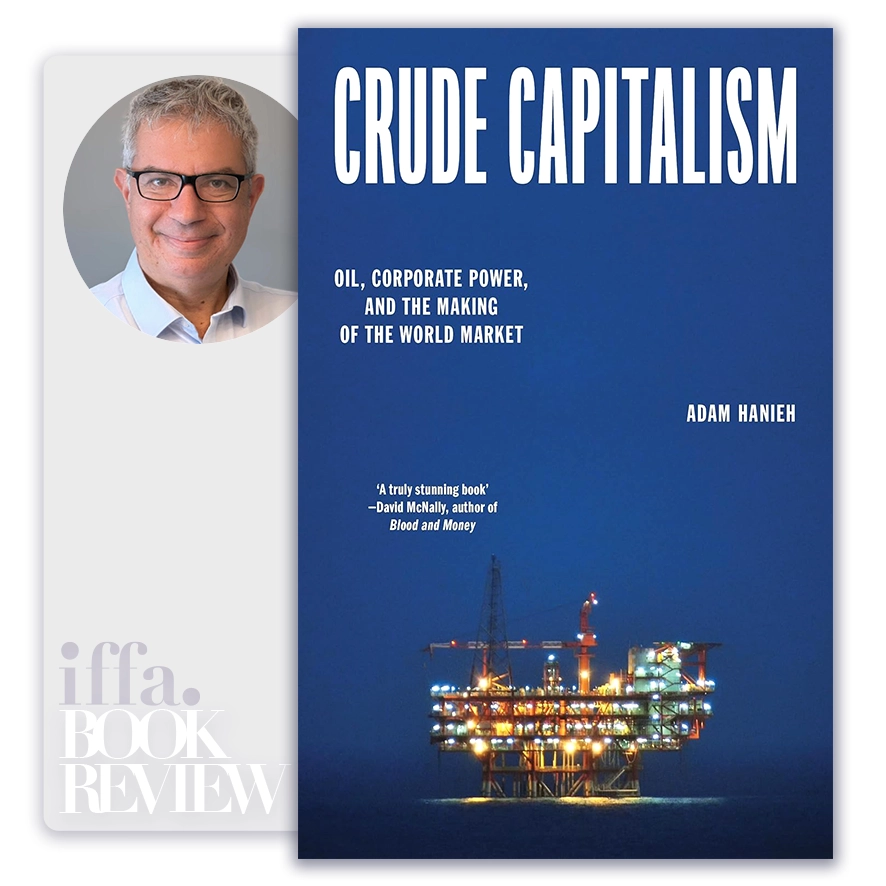
by Adam Hanieh
Summary Overview:
Oil is often discussed as a commodity, a revenue source, or a geopolitical lever. Crude Capitalism remains essential because it shows that oil is something more fundamental: a structural force shaping how modern capitalism is organized, governed, and reproduced. In an era of energy transition, geopolitical fragmentation, and rising state intervention, the book helps senior leaders understand why capital flows, corporate structures, and political alliances continue to orbit hydrocarbons long after their supposed decline. Its relevance lies in reframing energy not as a sector, but as an organizing principle of global power, with direct implications for strategy, governance, and long-term investment judgment.
About The Author
Adam Hanieh is a political economist whose work focuses on global capitalism, energy systems, and the political economy of the Middle East. His research background and academic appointments place him at the intersection of theory, regional expertise, and empirical analysis.
What distinguishes Hanieh’s perspective is his structural lens. Rather than analyzing oil through national politics or market cycles, he examines how corporate ownership, finance, and state power interlock, offering a systemic view that challenges conventional sector-based thinking.
Core Idea:
The core idea of Crude Capitalism is that oil has been central to the architecture of modern capitalism, not merely as fuel, but as a foundation for capital accumulation, state formation, and global financial integration. The book argues that oil-producing regions, particularly the Middle East, are not peripheral suppliers but core nodes in the organization of global capital.
Hanieh presents energy capitalism as a networked system, where multinational corporations, state-owned enterprises, banks, and governments co-evolve. Decisions about production, ownership, and pricing reflect structural power relations, not just efficiency or market logic. Executives who view oil markets without this lens underestimate how deeply energy shapes institutional behavior and long-term outcomes.
Oil is not an input to capitalism; it is one of its structural foundations.
Key Concepts:
- Oil and the Formation of Global Capital
Hanieh shows how oil revenues underpinned the expansion of multinational corporations and global finance. For executives, this reframes hydrocarbons as capital-forming infrastructure, not just extractive activity. - State Power and Corporate Integration
Rather than opposing forces, states and corporations are deeply integrated in energy systems. National oil companies, sovereign wealth funds, and regulatory regimes function as extensions of capital strategy, blurring public and private boundaries. - The Gulf as a Core Capital Hub
The book challenges the idea of the Middle East as a peripheral exporter. Instead, it highlights the Gulf as a central allocator of capital, influencing global investment patterns through finance, construction, and logistics. - Financialization of Energy Revenues
Oil wealth is recycled through global financial markets, real estate, and infrastructure. This recycling stabilizes capitalism while exporting volatility elsewhere, a critical insight for systemic risk assessment. - Labor, Migration, and Production Systems
Energy capitalism depends on transnational labor systems. Governance failures in labor markets reflect structural design, not temporary dysfunction, with implications for ESG, social risk, and legitimacy. - Energy and Imperial Stability
Oil has historically underwritten geopolitical order. The book explains how military, diplomatic, and economic arrangements are co-produced with energy flows, shaping long-term stability. - Crisis as Structural Adjustment
Oil price shocks are not anomalies but moments of system recalibration. Leaders who expect crisis resolution without structural change misjudge persistence and depth. - Energy Transition as Capital Reorganization
The shift toward renewables does not dismantle capitalism; it reorganizes it. Control over minerals, grids, and finance will replicate familiar power dynamics unless governance changes. - Regional Integration Over National Analysis
Hanieh emphasizes regional political economy rather than nation-states. Strategic planning that ignores regional capital networks overlooks real centers of influence. - Long-Term Inertia of Energy Systems
Energy infrastructures lock in behavior for decades. Strategic decisions today shape future constraints, reinforcing the need for long-horizon governance.
Energy systems reproduce power relations long before they generate revenue.
Executive Insights:
Crude Capitalism pushes leaders to move beyond sectoral thinking and view energy as systemic architecture. It explains why market reforms, diversification agendas, and transitions often underperform expectations: they operate within deeply embedded capital structures.
For boards and policymakers, the book reframes energy risk as structural and institutional, not cyclical.
- Energy shapes capital allocation beyond its sector
- State and corporate strategies are structurally intertwined
- Regional capital hubs matter more than national borders
- Transitions redistribute power before they reduce emissions
- Long-term governance outruns short-term reform
Actionable Takeaways:
Senior leaders should translate these insights into strategic posture and system design:
- Reframe energy exposure as structural, not sectoral
- Stop assuming diversification equals independence from oil systems
- Embed political economy analysis into long-term strategy
- Design transition strategies around capital flows, not slogans
- Align governance with system inertia, not short-term targets
Final Thoughts:
Crude Capitalism is a book about how power endures through systems. It challenges executives to confront uncomfortable truths about the foundations of modern prosperity and the limits of superficial reform.
Its enduring value lies in shifting attention from events to structures, from price movements to ownership patterns, and from intentions to outcomes. Leaders who grasp this distinction gain patience, realism, and strategic depth.
As energy systems evolve, the book’s final lesson becomes more urgent: lasting value is created not by escaping structural realities, but by understanding them deeply enough to govern change without illusion.
The ideas in this book go beyond theory, offering practical insights that shape real careers, leadership paths, and professional decisions. At IFFA, these principles are translated into executive courses, professional certifications, and curated learning events aligned with today’s industries and tomorrow’s demands. Discover more in our Courses.
Applied Programs

- Course Code : SBM-409
- Delivery : In-class / Virtual / Workshop
- Duration : 2-4 Days
- Venue: DUBAI HUB

- Course Code : PMA-613
- Delivery : In-class / Virtual / Workshop
- Duration : 3-5 Days
- Venue: DUBAI HUB
- Course Code : CIF-505
- Delivery : In-class / Virtual / Workshop
- Duration : 3-5 Days
- Venue: DUBAI HUB

- Course Code : CIF-512
- Delivery : In-class / Virtual / Workshop
- Duration : 2-4 Days
- Venue: DUBAI HUB
Related Books