The Executive Summary of
Crude Volatility
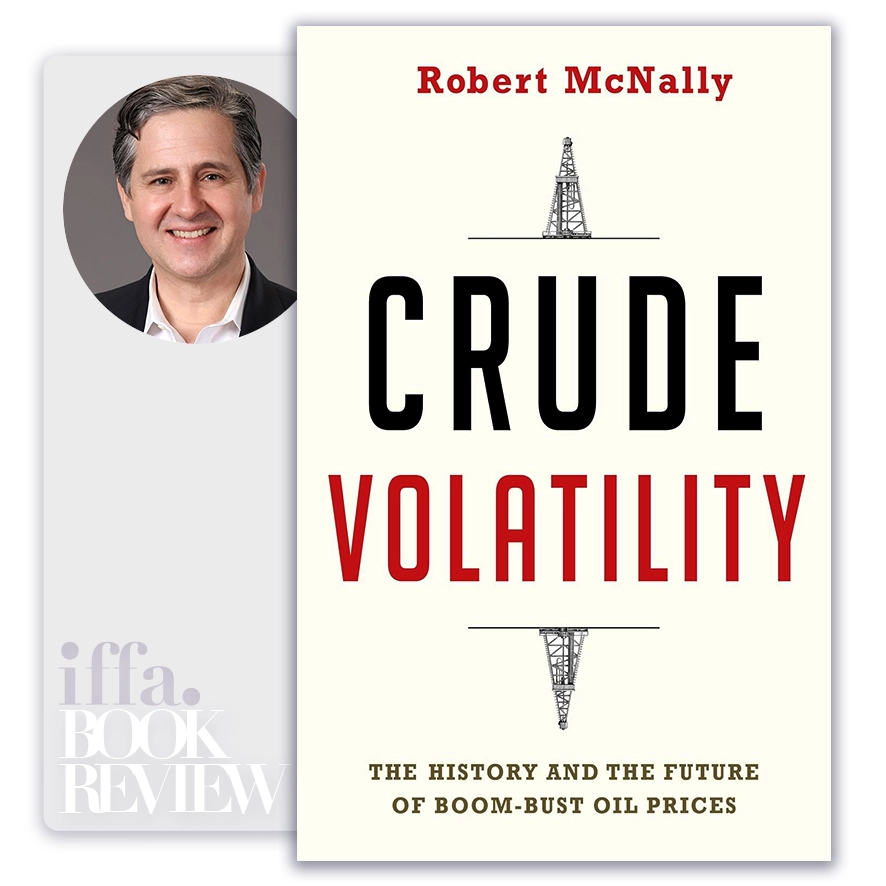
by Robert McNally
Summary Overview:
Oil price volatility is often explained as a function of supply and demand, market psychology, or exogenous shocks. Crude Volatility reframes that narrative by showing how state power, strategic intent, and policy choices repeatedly override textbook economics in shaping oil markets. Written with the perspective of someone who has operated inside government decision rooms, the book remains acutely relevant in an era defined by energy weaponization, geopolitical fragmentation, and chronic uncertainty. It sharpens executive judgment by revealing how price instability is not an accident of markets, but frequently a consequence of deliberate political action, misaligned incentives, and institutional blind spots that persist across cycles.
About The Author
Robert McNally is an energy strategist with direct experience at the intersection of oil markets, geopolitics, and public policy, including service at the highest levels of U.S. energy decision-making. His career spans government advisory roles, market analysis, and strategic consultancy, giving him a rare vantage point across policy formulation, market reaction, and unintended consequences.
What distinguishes McNally’s perspective is not ideological positioning, but operational realism. He writes as a practitioner who understands how governments actually behave under pressure, how political constraints distort market outcomes, and how institutional memory failures repeatedly lead policymakers and executives to underestimate volatility risk.
Core Idea:
The central thesis of Crude Volatility is that oil markets are governed as much by political intent and strategic miscalculation as by physical supply and demand. Price stability or instability is often the result of government actions, diplomatic signaling, sanctions, alliances, and domestic political trade-offs, rather than purely market-driven forces.
McNally argues that energy markets are political systems disguised as economic ones, and that leaders who ignore this reality systematically misread risk. Volatility emerges when policy ambition exceeds operational control, when governments attempt to manage prices without fully accounting for market feedback loops, institutional constraints, or geopolitical retaliation.
Oil price volatility is not a failure of markets, but a reflection of how power is exercised through them.
Key Concepts:
- Oil as a Strategic Asset, Not a Commodity
At the executive level, oil must be understood as a strategic instrument of statecraft. Governments treat oil prices as levers to influence inflation, growth, geopolitical rivals, and domestic legitimacy. This creates structural volatility because political objectives change faster than production capacity, and market participants are forced to react to policy signals rather than fundamentals. - The Myth of Market Neutrality
McNally dismantles the assumption that oil markets are neutral arenas. Interventions such as price controls, sanctions, strategic reserves, and diplomatic pressure systematically distort signals. For leaders, this means traditional forecasting models often fail because they exclude policy-driven asymmetries. - Policy Overreach and Unintended Consequences
Attempts to stabilize prices frequently produce the opposite effect. Short-term political fixes, such as suppressing prices to appease voters, discourage investment and create future supply shocks. Executives must recognize how temporal mismatches between political cycles and capital investment cycles generate instability. - OPEC’s Misunderstood Power
The book reframes OPEC not as an omnipotent cartel, but as a fragile political coalition managing internal conflicts, fiscal pressures, and external threats. Its influence fluctuates based on member discipline, spare capacity, and geopolitical alignment, not slogans or quotas. - Sanctions as Market Weapons
Sanctions reshape flows, pricing benchmarks, and risk premiums. McNally shows how sanctions often redistribute volatility rather than eliminate supply, creating opaque markets and reinforcing price swings. Strategically, sanctions introduce non-linear risk that standard models cannot capture. - Strategic Petroleum Reserves as Political Signals
SPR releases are less about volume and more about messaging. They signal government intent, influence expectations, and attempt to calm markets. Overuse, however, erodes credibility and reduces future crisis optionality, a critical governance concern. - Underinvestment Cycles and Political Short-Termism
Persistent volatility is fueled by systemic underinvestment, driven by regulatory uncertainty, ESG pressures, and political hostility toward fossil fuels without credible transition sequencing. Leaders face a paradox: discouraging supply while demanding price stability. - Energy Transitions Increase Volatility Before Reducing It
Transitions are not smooth substitutions. They introduce overlapping systems, stranded assets, and misaligned incentives, increasing volatility during the interim. Executives must plan for longer-than-expected dual-system instability. - Information Asymmetry and Narrative Risk
Markets move on narratives shaped by governments, media, and institutions. McNally highlights how misleading simplicity, such as blaming “speculators” or “greed,” obscures real drivers and delays corrective action. - Volatility as a Governance Failure
Ultimately, recurring oil shocks reflect institutional amnesia. Each crisis is treated as unique, preventing durable reforms. Strategic leadership requires memory, humility, and systems thinking, not reactive intervention.
The most dangerous risks in energy markets arise when policymakers believe they control outcomes they barely influence.
Executive Insights:
Crude Volatility reveals that energy instability is not a temporary aberration but a structural feature of politicized markets. Leaders who expect equilibrium are repeatedly surprised, while those who anticipate disruption preserve optionality and resilience. The book urges executives to replace prediction with preparedness.
At board level, the core implication is that oil exposure is not merely a price risk, but a policy, reputational, and strategic risk intertwined with national agendas and global power shifts.
- Leadership decisions must account for policy-driven volatility, not just market cycles
- Boards should treat energy exposure as a strategic risk category, not an operational cost
- Governments and corporations often share misaligned incentives that amplify instability
- Long-term planning requires acceptance of persistent uncertainty, not forecasts
- Credibility and restraint matter more than intervention frequency
Actionable Takeaways:
Senior leaders should internalize these principles as strategic behaviors, not tactics:
- Reframe volatility as a baseline condition, not an exception
- Design governance systems that preserve optionality under political shock
- Stop relying on linear forecasts in politically charged markets
- Embed policy-risk intelligence into capital allocation and strategy reviews
- Align investment horizons with structural reality, not electoral cycles
Final Thoughts:
Crude Volatility is ultimately a book about temperament in leadership. It shows how overconfidence, short-termism, and political expediency repeatedly undermine stability in one of the world’s most critical markets. The lesson is not that volatility can be eliminated, but that it can be anticipated, absorbed, and governed.
For executives, investors, and policymakers, the book offers a sober reminder that energy systems mirror the character of the institutions that manage them. Where governance is reactive, volatility compounds. Where leadership is disciplined, systems become resilient.
In an era where energy security, climate ambition, and geopolitical rivalry collide, McNally’s work stands as a guide to thinking clearly under pressure. The enduring takeaway is simple yet demanding: long-term value is created not by controlling outcomes, but by respecting complexity and preparing for disorder.
The ideas in this book go beyond theory, offering practical insights that shape real careers, leadership paths, and professional decisions. At IFFA, these principles are translated into executive courses, professional certifications, and curated learning events aligned with today’s industries and tomorrow’s demands. Discover more in our Courses.
Applied Programs

- Course Code : SBM-409
- Delivery : In-class / Virtual / Workshop
- Duration : 2-4 Days
- Venue: DUBAI HUB

- Course Code : PMA-613
- Delivery : In-class / Virtual / Workshop
- Duration : 3-5 Days
- Venue: DUBAI HUB
- Course Code : CIF-505
- Delivery : In-class / Virtual / Workshop
- Duration : 3-5 Days
- Venue: DUBAI HUB

- Course Code : CIF-512
- Delivery : In-class / Virtual / Workshop
- Duration : 2-4 Days
- Venue: DUBAI HUB
Related Books