
The Executive Summary of
Maritime Law
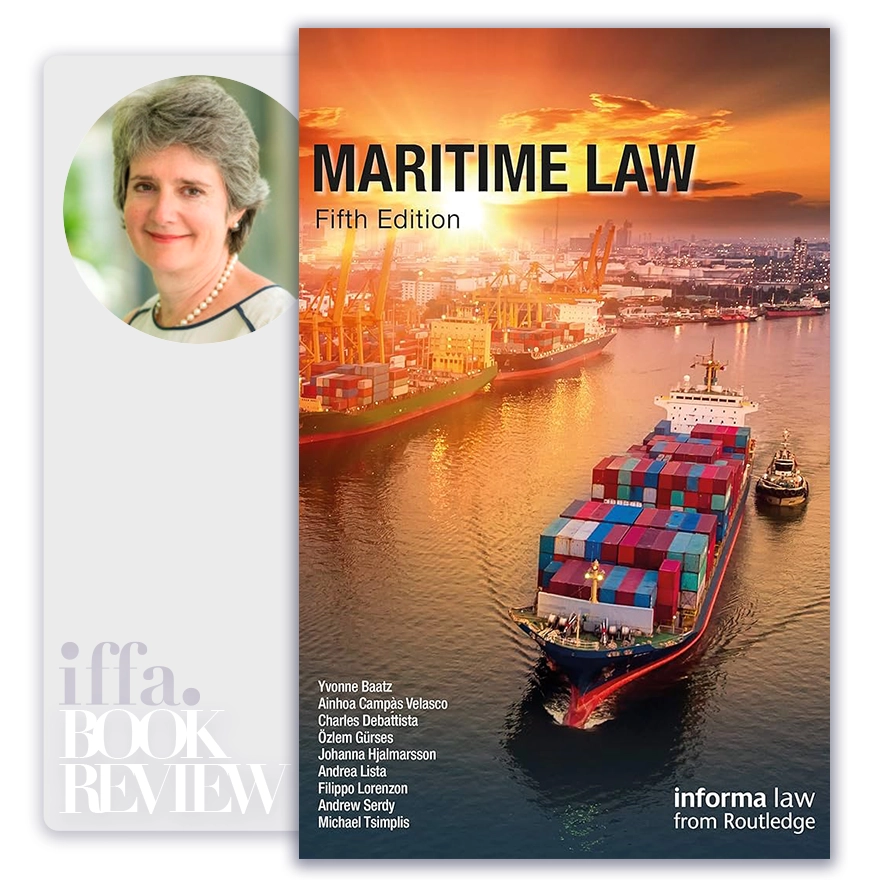
by Yvonne Baatz
Summary Overview:
Maritime Law (Routledge) stands as one of the most authoritative modern treatments of admiralty law, precisely because it bridges doctrinal clarity with contemporary commercial reality. As global trade becomes more regulated, more litigious, and more exposed to geopolitical, environmental, and technological risk, the legal framework governing shipping is no longer a specialist concern—it is a core enterprise risk system. Yvonne Baatz’s work matters because it explains how maritime law actually operates today, across jurisdictions, conventions, and contracts that increasingly intersect.
For CEOs, board members, shipowners, charterers, insurers, financiers, and logistics leaders, the book is essential because maritime law determines where risk ultimately sits when things go wrong. Casualties, pollution, cargo loss, sanctions, and crew issues do not merely test operational readiness; they test legal preparedness. Baatz shows that maritime law is not static tradition, but a living framework that continually adapts to modern shipping practices—making legal literacy a prerequisite for resilient governance in global trade.
About The Author
Yvonne Baatz is a leading maritime law scholar and editor, widely respected for her work on international shipping law and admiralty practice.
Her authority lies in combining academic rigor with practical relevance, presenting complex legal regimes in a way that reflects how courts, arbitrators, and commercial parties actually apply them in modern maritime disputes.
Core Idea:
The central thesis of Maritime Law is that shipping operates within a carefully calibrated legal ecosystem designed to balance risk, responsibility, and commercial viability. Baatz demonstrates that maritime law does not seek perfect justice in every case, but predictable outcomes that allow trade to function across borders, flags, and legal systems.
At a deeper level, the book presents a worldview in which law is a form of maritime infrastructure. Just as ports and vessels enable physical movement, legal rules enable trust, insurance, financing, and dispute resolution. Without coherent maritime law, global shipping would become fragmented, uninsurable, and commercially unstable.
Maritime law exists to make risk predictable where elimination is impossible.
Key Concepts:
- Admiralty Law Is International by Necessity
Shipping transcends borders.
- Uniformity reduces friction.
- Divergence increases dispute risk.
- Contracts Are the Primary Risk Engine
Charterparties and bills of lading allocate responsibility.
- Commercial terms shape legal exposure.
- Poor drafting amplifies loss.
- Liability Is Structured, Not Absolute
Maritime law limits exposure to preserve trade.
- Limitation regimes sustain insurability.
- Unlimited liability would halt commerce.
- Carriage of Goods Law Governs Trust
Cargo claims are central to shipping disputes.
- Conventions balance shipper and carrier interests.
- Documentation discipline is critical.
- Seaworthiness Is a Due Diligence Obligation
The standard is contextual.
- Fitness replaces perfection.
- Timing and circumstance matter.
- Collision and Casualty Rules Anticipate Failure
Accidents are expected realities.
- Fault allocation stabilizes outcomes.
- Predictability limits escalation.
- Salvage Law Aligns Incentives
Rescue is economically encouraged.
- Private action serves public interest.
- Reward sustains readiness.
- Pollution Liability Reflects Modern Risk
Environmental harm carries enterprise consequences.
- Strict regimes reshape exposure.
- Prevention becomes strategic.
- Jurisdiction and Choice of Law Are Strategic Decisions
Where disputes are heard matters greatly.
- Forum selection influences outcome.
- Foresight reduces litigation risk.
- Insurance Completes the Legal Framework
Coverage follows liability rules.
- Legal certainty underwrites insurance markets.
- Misalignment creates uninsured loss.
Global shipping depends on legal certainty as much as nautical skill.
Executive Insights:
Baatz’s Maritime Law reframes admiralty law as a governance discipline rather than a reactive legal specialty. Organizations that treat maritime law as an afterthought often discover too late that operational incidents become legal and financial crises because risk was misallocated upstream.
For boards and senior executives, the implication is clear: maritime legal structure must be integrated into commercial strategy, risk management, and capital decisions. Legal foresight stabilizes insurance costs, preserves counterparty trust, and limits downside exposure in an increasingly complex regulatory environment.
- Legal certainty underpins global trade.
- Risk allocation shapes cost and resilience.
- Jurisdictional planning reduces escalation.
- Environmental liability elevates board-level risk.
- Governance failures often precede maritime losses.
Actionable Takeaways:
Resilient shipping enterprises require legal discipline.
- Treat maritime contracts as strategic risk tools.
- Align commercial decisions with liability regimes.
- Anticipate jurisdiction and enforcement exposure early.
- Integrate environmental liability into enterprise risk.
- Embed maritime legal expertise into governance structures.
Final Thoughts:
Maritime Law by Yvonne Baatz affirms a foundational truth of global commerce: the sea may be unpredictable, but the rules governing it must not be. Her work demonstrates that admiralty law exists not to complicate shipping, but to make it possible at scale—by converting uncertainty into structured, manageable risk.
For leaders responsible for assets, capital, and reputation in maritime trade, the enduring lesson is clear: ships move goods, but law moves confidence. Where maritime law is understood and respected, commerce flows. Where it is ignored, risk multiplies.
In the long run, the strongest shipping enterprises are those that navigate law with the same discipline they navigate the sea.
The ideas in this book go beyond theory, offering practical insights that shape real careers, leadership paths, and professional decisions. At IFFA, these principles are translated into executive courses, professional certifications, and curated learning events aligned with today’s industries and tomorrow’s demands. Discover more in our Courses.
Applied Programs

- Course Code : SBM-409
- Delivery : In-class / Virtual / Workshop
- Duration : 2-4 Days
- Venue: DUBAI HUB

- Course Code : PMA-613
- Delivery : In-class / Virtual / Workshop
- Duration : 3-5 Days
- Venue: DUBAI HUB
- Course Code : CIF-505
- Delivery : In-class / Virtual / Workshop
- Duration : 3-5 Days
- Venue: DUBAI HUB

- Course Code : CIF-512
- Delivery : In-class / Virtual / Workshop
- Duration : 2-4 Days
- Venue: DUBAI HUB
Related Books