The Executive Summary of
The Ecology of Commerce
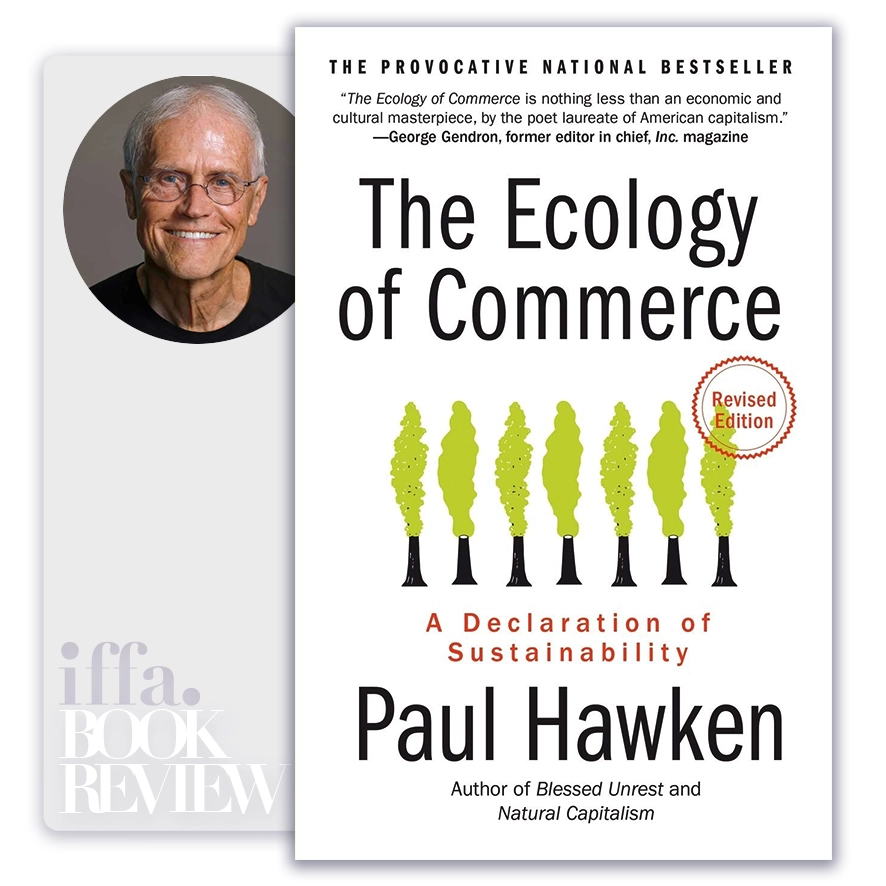
by Paul Hawken
Summary Overview:
The Ecology of Commerce is one of the earliest and most prescient works to argue that environmental collapse is not a failure of nature, but a failure of business design. Paul Hawken challenges the foundational assumptions of industrial capitalism, exposing how profit models that externalize environmental and social costs inevitably undermine the very markets they depend on. The book remains strikingly relevant as climate risk, biodiversity loss, and social instability increasingly intersect with financial performance and enterprise value.
For CEOs, board members, policymakers, and long-term investors, this book matters because it reframes sustainability from moral obligation to economic necessity. Hawken does not argue against commerce; he argues for its reinvention. He demonstrates that businesses operating in opposition to natural systems accumulate hidden liabilities, while those aligned with ecological principles build resilience, legitimacy, and long-term advantage. In an era of ESG scrutiny and systemic risk, The Ecology of Commerce reads less like critique and more like strategic foresight.
About The Author
Paul Hawken is an environmentalist, entrepreneur, and author whose work bridges business, ecology, and systems thinking. He has advised governments and corporations while founding and leading mission-driven enterprises.
Hawken’s authority comes from operating inside commerce rather than observing it from the outside. His insights are grounded in entrepreneurial experience, not ideological opposition to markets.
Core Idea:
The central thesis of The Ecology of Commerce is that the modern economy violates the basic principles of ecological systems, and therefore cannot endure in its current form. Hawken argues that businesses succeed only temporarily when they treat nature as an infinite input and a free waste sink.
At a deeper level, the book presents a worldview in which commerce must evolve from extractive to regenerative. Markets should reward restoration, efficiency, and social well-being rather than depletion. True profitability, in this framing, emerges when enterprises operate as contributors to the systems that sustain them—not as exploiters of externalized costs.
The purpose of business must shift from extraction to restoration.
Key Concepts:
- Externalized Costs Are Systemic Lies
Environmental damage is treated as invisible.
- Profitability is overstated when costs are displaced.
- Markets misprice reality.
- Business Is the Dominant Ecological Force
Corporations shape ecosystems more than governments.
- Scale creates responsibility.
- Influence demands stewardship.
- Growth Without Regeneration Is Unsustainable
Expansion detached from renewal accelerates collapse.
- Throughput matters more than size.
- Efficiency alone is insufficient.
- Waste Is a Design Failure
Pollution reflects poor system thinking.
- Nature has no waste.
- Circularity restores balance.
- Consumers Are Not the Primary Problem
Blame misdirects accountability.
- Producers design choices.
- Responsibility follows control.
- Regulation Is a Signal, Not an Obstacle
Environmental rules reveal systemic stress.
- Regulation compensates for market failure.
- Resistance delays adaptation.
- Transparency Changes Markets
Disclosure alters behavior.
- Visibility drives accountability.
- Hidden impacts persist.
- Restoration Is an Economic Opportunity
Repair creates value.
- Regenerative industries expand markets.
- Healing ecosystems supports growth.
- Leadership Determines Trajectory
Change begins at the top.
- Values shape strategy.
- Courage enables transition.
- Capitalism Can Be Reformed
The system is adaptable.
- Markets respond to rules and incentives.
- Design determines outcome.
Kaizen works not because it is simple, but because it is sustained.
Executive Insights:
The Ecology of Commerce reframes sustainability as a strategic correction to market distortion, not an ethical add-on. Hawken shows that environmental degradation represents deferred cost and accumulated risk that eventually destabilizes firms, industries, and economies. Businesses that ignore ecological limits gain short-term advantage at the expense of long-term viability.
For boards and investors, the implication is unambiguous: ecological misalignment is financial misalignment. Long-term value creation depends on whether organizations internalize environmental costs, redesign products and supply chains, and participate in regenerative economic models.
- Environmental risk is enterprise risk.
- Regeneration supports long-term profitability.
- Transparency reshapes incentives.
- Design choices determine impact.
- Leadership courage accelerates transition.
Actionable Takeaways:
Sustainable commerce requires systemic redesign.
- Internalize environmental and social costs.
- Shift from linear to regenerative business models.
- Treat waste as a design signal, not a byproduct.
- Align strategy with ecological limits.
- Govern for long-term system health, not short-term gain.
Final Thoughts:
The Ecology of Commerce is neither anti-business nor idealistic. It is a sober recognition that economic systems cannot outgrow the natural systems that support them. Paul Hawken’s insight is that the future of capitalism depends not on restraint alone, but on imagination—on redesigning commerce to heal rather than harm.
For leaders entrusted with long-term stewardship, the book delivers a lasting conclusion: business will either become regenerative by choice, or restrictive by force. The window for voluntary transformation is finite.
In the long run, the most successful companies will be those that make commerce an ally of life, not its adversary.
The ideas in this book go beyond theory, offering practical insights that shape real careers, leadership paths, and professional decisions. At IFFA, these principles are translated into executive courses, professional certifications, and curated learning events aligned with today’s industries and tomorrow’s demands. Discover more in our Courses.
Applied Programs

- Course Code : SBM-409
- Delivery : In-class / Virtual / Workshop
- Duration : 2-4 Days
- Venue: DUBAI HUB

- Course Code : PMA-613
- Delivery : In-class / Virtual / Workshop
- Duration : 3-5 Days
- Venue: DUBAI HUB
- Course Code : CIF-505
- Delivery : In-class / Virtual / Workshop
- Duration : 3-5 Days
- Venue: DUBAI HUB

- Course Code : CIF-512
- Delivery : In-class / Virtual / Workshop
- Duration : 2-4 Days
- Venue: DUBAI HUB
Related Books