
The Executive Summary of
The Lean Six Sigma Pocket Toolbook
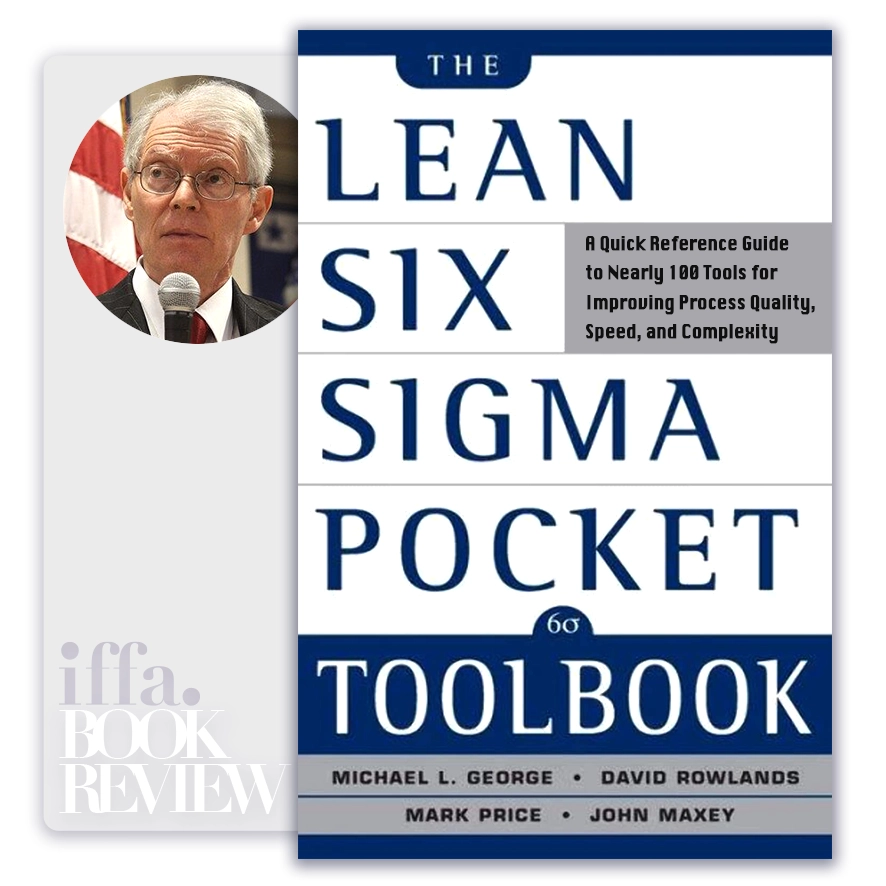
by Michael L. George
Summary Overview:
The Lean Six Sigma Pocket Toolbook brings discipline and clarity to a space often clouded by slogans and partial adoption. Lean and Six Sigma are widely endorsed at leadership level, yet many organizations struggle to translate intent into consistent results. Improvement efforts stall not because the philosophy is flawed, but because teams lack a shared, practical command of the tools that turn analysis into action.
This book positions tools not as technical checklists, but as enablers of sound judgment and repeatable execution. For executives, operations leaders, and transformation sponsors, its value lies in standardizing how problems are defined, analyzed, and resolved across the organization. In complex environments—where cost pressure, quality risk, and variability coexist—the ability to apply the right tool at the right moment becomes a strategic capability. The Lean Six Sigma Pocket Toolbook provides a compact but rigorous foundation for embedding improvement into daily management, ensuring that operational excellence is systematic, scalable, and sustained rather than dependent on individual expertise or ad-hoc initiatives.
About The Author
Michael L. George was a leading authority in Lean Six Sigma deployment, advising global organizations on large-scale operational transformation. David Rowlands, Mark Price, and John Maxey are experienced practitioners whose backgrounds span manufacturing, services, and enterprise process improvement.
Their collective perspective is distinctive because it is practice-driven rather than academic. The authors focus on how tools are actually used in real organizations—under time pressure, political constraints, and imperfect data—making the book a reliable operational companion rather than an abstract manual.
Core Idea:
The core idea of The Lean Six Sigma Pocket Toolbook is that sustained operational excellence depends on disciplined use of the right tools at the right time, guided by a clear problem-solving structure. Lean and Six Sigma are not competing philosophies but complementary systems: Lean improves flow and eliminates waste, while Six Sigma reduces variation and defects.
The book positions tools as decision aids, not checklists. When used correctly, they bring clarity to complex processes, align teams around facts rather than opinions, and enable leaders to intervene with precision. Without this discipline, improvement efforts devolve into slogans, disconnected initiatives, or superficial gains that fail to endure.
Tools do not replace judgment; they sharpen it.
Key Concepts:
- Improvement Requires a Structured Problem-Solving Path
The book reinforces the DMAIC logic—Define, Measure, Analyze, Improve, Control—as a governance framework. At executive level, this matters because structure prevents premature solutions and wasted effort.
- Clear definition precedes action
- Measurement grounds debate
- Control sustains gains
- Tools Create a Shared Language of Performance
When teams use consistent tools, discussions shift from opinion to evidence. This alignment reduces friction across functions.
- Facts replace hierarchy
- Transparency improves trust
- Decisions become comparable
Executively, this supports scalable improvement across portfolios.
- Waste and Variation Are Strategic Risks
Lean identifies waste; Six Sigma exposes variation. Both represent hidden costs that erode margin, quality, and customer trust.
- Waste consumes capacity
- Variation destabilizes outcomes
- Visibility enables control
Leaders who ignore these forces manage symptoms, not causes.
- Process Thinking Over Functional Silos
Many tools—process maps, value stream maps—force organizations to see work end-to-end. Strategically, this challenges siloed optimization that harms system performance.
- Local efficiency can damage global flow
- Cross-functional visibility reveals constraints
- System performance improves coordination
- Data as a Tool for Learning, Not Blame
Measurement tools are framed as learning mechanisms, not surveillance. This distinction is critical for cultural adoption.
- Fear distorts data
- Learning accelerates improvement
- Trust sustains transparency
Executives who misuse metrics undermine the very discipline they seek.
- Root Cause Over Symptom Fixing
Analytical tools such as cause-and-effect diagrams and hypothesis testing push teams beyond surface explanations.
- Symptoms recur when causes persist
- Root cause clarity saves resources
- Depth beats speed
This principle directly supports long-term operational stability.
- Prioritization Is a Leadership Responsibility
Not all problems deserve equal attention. Tools like Pareto analysis help leaders allocate effort where impact is highest.
- Focus multiplies results
- Diffusion dilutes improvement
- Choice reflects judgment
- Improvement Must Be Designed Into Control Systems
Control tools ensure gains do not erode once attention shifts. At executive level, this reinforces that sustainability is a design choice, not an afterthought.
- Control prevents regression
- Ownership stabilizes performance
- Systems outlast initiatives
- Capability Building Beats Consultant Dependency
The book implicitly argues for internal capability. Tools empower teams to solve problems independently.
- Capability compounds
- Dependency weakens resilience
- Learning organizations outperform
This insight is critical for long-term transformation economics.
- Tools Support Judgment, Not Bureaucracy
Used poorly, tools become ritualistic. Used well, they enhance leadership judgment.
- Simplicity improves adoption
- Relevance drives usage
- Discipline enables speed
Executives set the tone for whether tools clarify or clutter.
Operational excellence emerges when problems are defined clearly before solutions are applied.
Executive Insights:
The Lean Six Sigma Pocket Toolbook reframes operational excellence as a governance discipline, not a program. Its insights explain why many Lean or Six Sigma initiatives fail: leaders endorse the philosophy but neglect the operational rigor required to sustain it.
For executives and boards, the book highlights that improvement must be institutionalized through common tools, shared language, and consistent expectations. When tools are embedded into decision-making, organizations reduce reliance on intuition and firefighting.
The book also underscores a critical leadership truth: complexity does not excuse vagueness. In fact, complexity demands more structure, not less.
Actionable Takeaways:
The book offers principle-driven guidance for leaders and organizations.
- Use structured problem-solving to govern improvement
- Treat tools as decision aids, not compliance tasks
- Build shared operational language across functions
- Focus on root causes and system performance
- Design controls to sustain gains
- Invest in internal improvement capability
- Reinforce discipline through leadership behavior
Final Thoughts:
The Lean Six Sigma Pocket Toolbook is ultimately a book about clarity under operational complexity. It reminds leaders that improvement is not a matter of enthusiasm or slogans, but of disciplined thinking applied consistently.
The enduring insight of the book is clear: organizations that master simple tools deeply outperform those that chase complex strategies superficially. For leaders committed to durable excellence, this pocket reference is less a manual—and more a quiet blueprint for how execution truly works.
The ideas in this book go beyond theory, offering practical insights that shape real careers, leadership paths, and professional decisions. At IFFA, these principles are translated into executive courses, professional certifications, and curated learning events aligned with today’s industries and tomorrow’s demands. Discover more in our Courses.
Applied Programs

- Course Code : SBM-409
- Delivery : In-class / Virtual / Workshop
- Duration : 2-4 Days
- Venue: DUBAI HUB

- Course Code : PMA-613
- Delivery : In-class / Virtual / Workshop
- Duration : 3-5 Days
- Venue: DUBAI HUB
- Course Code : CIF-505
- Delivery : In-class / Virtual / Workshop
- Duration : 3-5 Days
- Venue: DUBAI HUB

- Course Code : CIF-512
- Delivery : In-class / Virtual / Workshop
- Duration : 2-4 Days
- Venue: DUBAI HUB
Related Books