The Executive Summary of
Think and Grow Rich
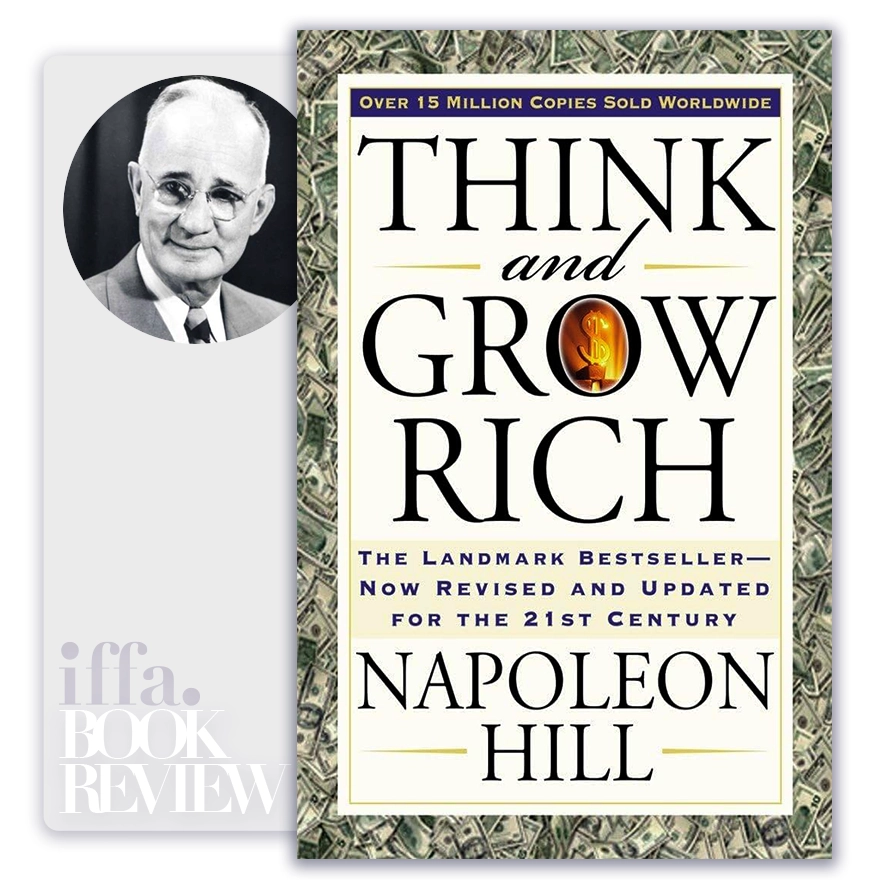
by Napoleon Hill
Summary Overview:
Think and Grow Rich occupies a unique place in the literature of success because it focuses not on tactics, markets, or professions, but on the mental discipline behind sustained achievement. Written in the shadow of economic collapse, the book emerged from a long study of individuals who built influence, enterprises, and wealth under conditions of uncertainty, constraint, and repeated failure. Its endurance lies in addressing a question that remains unresolved today: why do some people compound progress over time while others, equally capable, stall or reverse course?
Rather than treating success as a function of opportunity or intelligence, the book frames it as a product of clarity of purpose, consistency of thought, and emotional control over long horizons. For executives, investors, and leaders operating in volatile environments, this perspective is especially relevant. Strategy changes, markets shift, and tools evolve, but the ability to maintain conviction, make decisive judgments, and persist without self-sabotage remains a constant determinant of outcomes. Think and Grow Rich positions success not as an event, but as a deliberate process shaped quietly by mindset, discipline, and time.
About The Author
Napoleon Hill was a journalist and researcher who spent over 20 years studying influential figures such as Andrew Carnegie, Henry Ford, and Thomas Edison. His authority comes from synthesizing observed success patterns into a coherent mental framework, rather than offering technical or financial instruction.
Core Idea:
The core idea of Think and Grow Rich is that achievement begins as a disciplined mental process before it becomes a material result. Hill argues that wealth—financial or otherwise—is not accidental. It is the product of clear purpose, controlled thinking, persistence, and the ability to organize effort toward a defined aim.
Crucially, the book treats “riches” broadly. While financial success is central, the underlying principles apply equally to leadership, influence, organizational growth, and personal mastery. Hill’s thesis is not that thought alone creates results, but that thinking determines the quality, direction, and consistency of action over time.
What the mind can conceive and believe, it can achieve—when belief is matched with sustained action.
Key Concepts:
- Definite Purpose as Strategic Anchor
Hill places clarity of purpose at the center of all achievement. At executive level, this matters because organizations drift when leaders pursue multiple, shifting objectives without hierarchy or conviction.
- A definite purpose aligns decisions over time
- Clarity filters opportunity from distraction
- Ambiguity weakens persistence
Hill frequently references Andrew Carnegie, whose singular focus on steel shaped every strategic choice, investment, and partnership he made.
- Desire Transformed Into Commitment
Desire, in Hill’s framework, is not wishful thinking but emotional commitment reinforced by action. Leaders who lack conviction struggle to mobilize others or endure adversity.
- Strong desire sustains effort under pressure
- Commitment outlasts motivation
- Intensity differentiates ambition from intent
Executively, this explains why bold strategies fail without leadership conviction behind them.
- Faith as Internal Consistency
Hill defines faith as confidence reinforced through repetition and evidence, not blind belief. For leaders, this translates into self-trust built through disciplined preparation and consistency.
- Confidence influences decision quality
- Doubt spreads faster than certainty
- Repetition strengthens belief systems
Organizations often mirror the internal certainty—or uncertainty—of their leaders.
- Specialized Knowledge Over General Intelligence
Hill distinguishes between general education and applied, situation-specific knowledge. At strategic level, this reinforces the importance of knowing what matters most now, rather than knowing everything.
- Relevance beats breadth
- Learning must align with purpose
- Knowledge unused has no strategic value
Many leaders Hill studied surrounded themselves with experts rather than attempting mastery alone.
- Imagination as Strategic Design Tool
Hill highlights imagination as the source of all progress—the ability to envision combinations that do not yet exist. At executive level, imagination underpins innovation, strategy, and organizational reinvention.
- Synthetic imagination recombines existing ideas
- Creative imagination generates new models
- Vision precedes execution
Henry Ford’s assembly line is presented as a product of imagination before it was an operational system.
- Organized Planning and Adaptive Execution
Plans rarely succeed fully as designed. Hill emphasizes organized planning combined with flexibility, a lesson central to long-term leadership.
- Plans guide direction, not certainty
- Failure is feedback, not defeat
- Adaptation preserves momentum
Executives who persist with flawed plans out of pride often destroy value; those who adjust preserve it.
- Decision as a Marker of Leadership Strength
Hill observes that successful individuals decide quickly and change slowly. Indecision erodes confidence, credibility, and opportunity.
- Decisiveness builds authority
- Delay signals doubt
- Reversals weaken trust
At board and executive level, delayed decisions often cost more than imperfect ones made early.
- Persistence as Competitive Advantage
Hill identifies persistence as a defining trait of high achievers. Strategically, persistence compounds advantage because most competitors withdraw early.
- Persistence outlasts talent gaps
- Resistance tests commitment
- Endurance filters leadership quality
Many examples in the book highlight individuals who succeeded only after repeated failure and rejection.
- The Master Mind Principle
Hill introduces the idea that coordinated intelligence multiplies outcomes. No major success is achieved alone.
- Collective judgment reduces blind spots
- Shared purpose accelerates execution
- Isolation limits scale
At executive level, this underscores the strategic importance of aligned leadership teams over heroic individualism.
- Control of Thought and Emotional Discipline
Hill emphasizes mastery over impulses, fear, and negative thinking. For leaders, emotional discipline directly affects judgment under stress.
- Fear distorts strategy
- Emotional control stabilizes decisions
- Inner order enables outer execution
Organizations led by reactive leaders tend to mirror instability in culture and performance.
Sustained success is rarely the result of luck, but of organized intention.
Executive Insights:
Think and Grow Rich reframes leadership as a long-term mental discipline, not a series of tactical moves. Its central implication is that sustained success depends less on circumstances than on how leaders interpret, commit to, and act within those circumstances.
For executives and boards, the book highlights that clarity, decisiveness, and persistence are not personality traits—they are practices. Organizations that institutionalize these qualities outperform those that rely on charisma, luck, or short-term incentives.
The book also warns against dispersion of focus. Many failures stem not from wrong strategy, but from inconsistent thinking and diluted purpose at the top.
Actionable Takeaways:
The book offers enduring principles applicable across leadership contexts.
- Anchor strategy in a clear, definite purpose
- Cultivate conviction through preparation and repetition
- Prioritize specialized, purpose-driven knowledge
- Treat imagination as a strategic asset
- Decide decisively and review deliberately
- Persist beyond early resistance and setbacks
- Build aligned leadership circles, not isolated authority
- Practice emotional discipline under pressure
Final Thoughts:
Think and Grow Rich endures because it addresses the invisible drivers of visible success. Napoleon Hill does not offer formulas for wealth; he offers a framework for sustained achievement rooted in clarity, discipline, and purposeful action.
The enduring insight of the book is simple but demanding: long-term success is rarely the result of extraordinary opportunity, but of ordinary decisions executed consistently over time. Leaders who internalize this principle stop searching for breakthroughs and begin building foundations—allowing results to compound quietly, predictably, and durably.
The ideas in this book go beyond theory, offering practical insights that shape real careers, leadership paths, and professional decisions. At IFFA, these principles are translated into executive courses, professional certifications, and curated learning events aligned with today’s industries and tomorrow’s demands. Discover more in our Courses.
Applied Programs

- Course Code : SBM-409
- Delivery : In-class / Virtual / Workshop
- Duration : 2-4 Days
- Venue: DUBAI HUB

- Course Code : PMA-613
- Delivery : In-class / Virtual / Workshop
- Duration : 3-5 Days
- Venue: DUBAI HUB
- Course Code : CIF-505
- Delivery : In-class / Virtual / Workshop
- Duration : 3-5 Days
- Venue: DUBAI HUB

- Course Code : CIF-512
- Delivery : In-class / Virtual / Workshop
- Duration : 2-4 Days
- Venue: DUBAI HUB
Related Books