The Executive Summary of
The Death and Life of Great American Cities
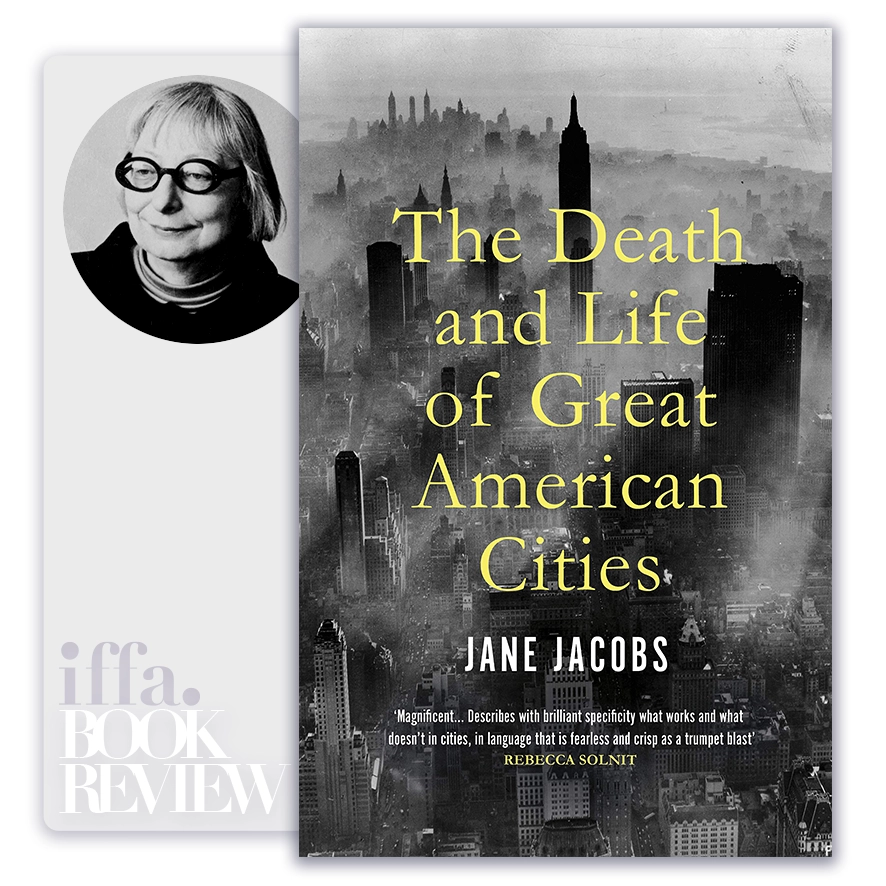
by Jane Jacobs
Summary Overview:
The Death and Life of Great American Cities remains one of the most influential works on urban life because it challenges a persistent leadership temptation: the belief that large-scale problems require top-down, simplified solutions. Jane Jacobs wrote in opposition to mid-20th-century urban planning orthodoxy, yet her insights feel increasingly contemporary as cities worldwide struggle with livability, social fragmentation, and brittle infrastructure. The book matters today because it exposes how well-intentioned, expert-driven interventions can quietly destroy the very vitality they aim to improve.
For mayors, policymakers, developers, institutional investors, and urban strategists, the book addresses a deeper governance question: how do complex human systems actually function when left room to self-organize? Jacobs demonstrates that cities thrive not through rigid control, but through dense networks of everyday interactions, informal oversight, and mixed uses that generate safety, economic opportunity, and cultural life. Leaders should care because urban failure is rarely sudden—it emerges gradually when planners ignore lived experience in favor of abstract order.
About The Author
Jane Jacobs was a writer, activist, and urban thinker whose work reshaped how cities are understood and governed. Though not formally trained as a planner, she became one of the most influential critics of modernist urban planning.
Jacobs’s authority came from close observation rather than institutional power. She studied how streets, neighborhoods, and communities actually functioned day to day, giving her perspective a grounded realism that challenged expert consensus. Her work endures because it prioritizes human behavior over theoretical models.
Core Idea:
The central thesis of The Death and Life of Great American Cities is that cities are complex, living systems whose vitality depends on diversity, density, and continuous human presence. Jacobs argues that attempts to simplify cities—through single-use zoning, large superblocks, and segregated functions—undermine safety, economic dynamism, and social cohesion.
At a deeper level, the book presents a worldview in which order emerges from interaction, not design alone. Healthy cities are not neat or predictable; they are messy, adaptive, and resilient precisely because they allow countless small decisions to interact. Leadership fails when it mistakes visual order for functional health.
Cities work best when complexity is allowed to organize itself through daily human activity.
Key Concepts:
- Diversity Is the Engine of Urban Life
Jacobs emphasizes mixed uses—residential, commercial, cultural—within close proximity.
- Diversity creates continuous activity.
- Monofunctional zones create emptiness and risk.
- Eyes on the Street Create Safety
Public safety emerges from natural surveillance, not heavy policing.
- Active streets discourage crime.
- Social presence replaces formal control.
- Short Blocks Encourage Interaction
Frequent intersections increase movement choices and encounters.
- Connectivity improves economic and social exchange.
- Long blocks suppress vitality.
- Density Enables Opportunity
Jacobs distinguishes density from overcrowding.
- Density supports services and innovation.
- Dispersal weakens community networks.
- Old Buildings Enable Economic Entry
A mix of building ages supports affordability and experimentation.
- New-only districts exclude small enterprises.
- Aging stock enables diversity.
- Planning Must Respect Local Knowledge
Top-down planning often ignores street-level realities.
- Residents understand functional patterns.
- Centralized assumptions misfire.
- Simplification Produces Fragility
Uniformity reduces adaptability.
- Homogeneity increases systemic risk.
- Variety supports resilience.
- Urban Renewal Can Destroy Value
Large-scale clearance often eliminates functioning ecosystems.
- Renewal disrupts social capital.
- Losses are underestimated.
- Cities Are Economic Incubators
Urban environments generate innovation through proximity and chance encounters.
- Informal interaction fuels creativity.
- Segregation limits cross-pollination.
- Governance Must Be Humble
Jacobs advocates restraint and observation.
- Overconfidence damages systems.
- Stewardship outperforms control.
Urban vitality cannot be engineered from above; it must be cultivated from below.
Executive Insights:
The Death and Life of Great American Cities reframes urban leadership as the governance of complexity rather than the imposition of order. Jacobs shows that many urban failures originate not from neglect, but from excessive confidence in abstract planning models that ignore human behavior.
For public authorities, investors, and developers, the implication is clear: long-term urban value depends on adaptability, mixed use, and human presence. Cities that privilege efficiency over vitality may look orderly, but they lose the social and economic engines that sustain them.
- Urban resilience depends on diversity.
- Safety emerges from social presence.
- Economic vitality requires informal interaction.
- Planning should enable, not replace, local systems.
- Long-term value favors complexity over uniformity.
Actionable Takeaways:
Effective urban leadership respects lived complexity.
- Design for mixed uses rather than single purposes.
- Preserve and integrate existing urban fabric.
- Encourage density with human-scale design.
- Value local knowledge alongside expert models.
- Govern cities as evolving systems, not static plans.
Final Thoughts:
The Death and Life of Great American Cities is ultimately a defense of human-scale intelligence against bureaucratic abstraction. Jane Jacobs reminds leaders that cities succeed when they support the everyday rhythms of life—work, movement, observation, and interaction—rather than imposing artificial order from above.
For those shaping the future of cities, the book offers a lasting insight: the health of an urban system is measured not by how it looks on paper, but by how it feels and functions on the street. Complexity, when respected, becomes strength.
Great cities live not because they are planned perfectly, but because they are allowed to live at all.
The ideas in this book go beyond theory, offering practical insights that shape real careers, leadership paths, and professional decisions. At IFFA, these principles are translated into executive courses, professional certifications, and curated learning events aligned with today’s industries and tomorrow’s demands. Discover more in our Courses.
Applied Programs

- Course Code : SBM-409
- Delivery : In-class / Virtual / Workshop
- Duration : 2-4 Days
- Venue: DUBAI HUB

- Course Code : PMA-613
- Delivery : In-class / Virtual / Workshop
- Duration : 3-5 Days
- Venue: DUBAI HUB
- Course Code : CIF-505
- Delivery : In-class / Virtual / Workshop
- Duration : 3-5 Days
- Venue: DUBAI HUB

- Course Code : CIF-512
- Delivery : In-class / Virtual / Workshop
- Duration : 2-4 Days
- Venue: DUBAI HUB
Related Books