The Executive Summary of
The Psychology of Money
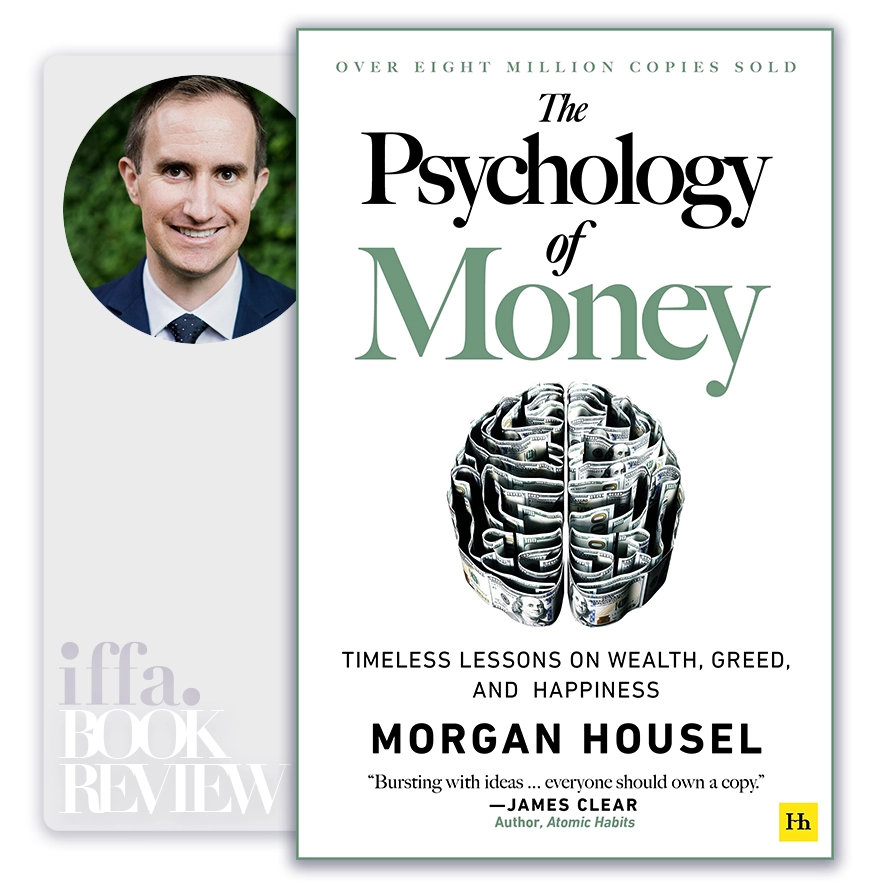
by Morgan Housel
Summary Overview:
The Psychology of Money endures because it confronts a reality that sophisticated models and credentials often overlook: financial outcomes are driven less by what people know and more by how they behave over time. In markets shaped by uncertainty, narratives, and incentives, technical competence alone does not protect leaders or investors from costly errors. The book reframes money as a human system—one governed by emotion, identity, patience, and context—rather than a purely mathematical one.
For CEOs, board members, and long-term investors, Housel’s work addresses a deeper leadership challenge: judgment under uncertainty. Capital allocation, risk management, compensation design, and strategy all hinge on assumptions about human behavior. When those assumptions are unrealistic, organizations court fragility. The book matters because it clarifies why reasonable decisions can outperform brilliant ones, why resilience beats optimization, and why aligning incentives with long horizons is central to durable success.
About The Author
Morgan Housel is a financial writer and investor known for translating complex market dynamics into clear insights about behavior and risk. His work draws on history, behavioral psychology, and investing experience to illuminate patterns that persist across cycles.
Housel’s perspective is distinctive for its emphasis on temperament over technique. Rather than offering forecasts or formulas, he examines how people respond to luck, fear, greed, and time—forces that quietly dominate outcomes in finance and leadership alike.
Core Idea:
The central thesis of The Psychology of Money is that financial success is a function of behavior, not intelligence. People with modest knowledge but disciplined habits often outperform experts who overestimate their control. Markets reward patience, humility, and consistency far more reliably than brilliance.
At a broader level, the book presents a worldview in which risk, luck, and uncertainty are permanent features, not anomalies. Effective decision-making accepts these realities and designs systems that can endure them. The goal is not to predict the future, but to remain solvent, flexible, and calm across many possible futures.
Financial outcomes reflect how people behave under uncertainty more than how well they understand theory.
Key Concepts:
- Behavior Dominates Outcomes
Housel shows that discipline, patience, and emotional control matter more than analytical sophistication.
- Poor behavior negates good analysis.
- Consistency compounds more reliably than brilliance.
- Luck and Risk Are Indistinguishable in Real Time
Success often blends skill with favorable circumstances, while failure blends mistakes with bad timing.
- Over-attributing outcomes to skill distorts learning.
- Humility improves long-term judgment.
- Time Is the Most Powerful Variable
Compounding works not through intensity, but through duration without interruption.
- Staying invested matters more than entry timing.
- Survival precedes optimization.
- Reasonable Beats Rational
The most effective decisions are those people can stick with emotionally.
- Theoretically optimal strategies fail if abandoned.
- Sustainability of behavior defines success.
- Volatility Is the Price of Admission
Market volatility is not a flaw; it is the cost of participation.
- Avoiding volatility often increases hidden risk.
- Acceptance reduces reactive decision-making.
- Tail Events Shape History
Rare, extreme events dominate outcomes in markets and organizations.
- Linear thinking underestimates impact.
- Resilience must account for extremes.
- Incentives Shape Risk-Taking
People respond predictably to incentives, often at the expense of long-term stability.
- Misaligned incentives create fragile systems.
- Governance must anticipate behavioral responses.
- Wealth Is What You Don’t See
Savings, flexibility, and optionality matter more than visible consumption.
- Optionality increases strategic freedom.
- Fragility often hides behind success.
- Financial Goals Are Personal
Risk tolerance and definitions of success vary widely.
- Universal rules mislead.
- Context determines appropriate strategy.
- Margin of Safety Is Strategic, Not Conservative
Buffers are not inefficiencies; they are enablers of endurance.
- Slack absorbs shocks.
- Tight systems fail under stress.
The ability to endure volatility is a competitive advantage that compounds over time.
Executive Insights:
The Psychology of Money underscores that organizational performance depends on behavioral design as much as analytical rigor. Leaders who overestimate precision and underestimate emotion create brittle strategies. Those who design for uncertainty, patience, and incentive alignment build durability.
For boards and long-term investors, the message is clear: risk is best managed through structure and temperament, not prediction. Capital allocation, compensation, and growth targets should privilege survivability and flexibility over short-term optimization.
- Evaluate strategies for behavioral sustainability.
- Design incentives that reward long-term outcomes.
- Treat volatility as a structural reality.
- Build buffers as strategic assets.
- Prioritize endurance over cleverness.
Actionable Takeaways:
Effective financial leadership begins with behavioral realism.
- Design systems that people can adhere to in stress.
- Reduce dependence on forecasts and precision.
- Accept volatility while protecting against ruin.
- Build margins of safety into capital and operations.
- Align incentives with patience and long horizons.
Final Thoughts:
The Psychology of Money offers a quietly radical insight: success is less about mastering finance and more about mastering oneself. Housel’s contribution is not a new model, but a clearer lens—one that recognizes uncertainty as permanent and behavior as decisive.
For leaders and investors navigating complex systems, the book affirms a timeless principle: the strongest strategies are those that survive bad luck, human emotion, and the passage of time. Endurance, humility, and discipline are not soft virtues; they are structural advantages.
In the long run, temperament outperforms intelligence, and survival outperforms optimization.
The ideas in this book go beyond theory, offering practical insights that shape real careers, leadership paths, and professional decisions. At IFFA, these principles are translated into executive courses, professional certifications, and curated learning events aligned with today’s industries and tomorrow’s demands. Discover more in our Courses.
Applied Programs

- Course Code : SBM-409
- Delivery : In-class / Virtual / Workshop
- Duration : 2-4 Days
- Venue: DUBAI HUB

- Course Code : PMA-613
- Delivery : In-class / Virtual / Workshop
- Duration : 3-5 Days
- Venue: DUBAI HUB
- Course Code : CIF-505
- Delivery : In-class / Virtual / Workshop
- Duration : 3-5 Days
- Venue: DUBAI HUB

- Course Code : CIF-512
- Delivery : In-class / Virtual / Workshop
- Duration : 2-4 Days
- Venue: DUBAI HUB
Related Books