The Executive Summary of
Tap Dancing to Work
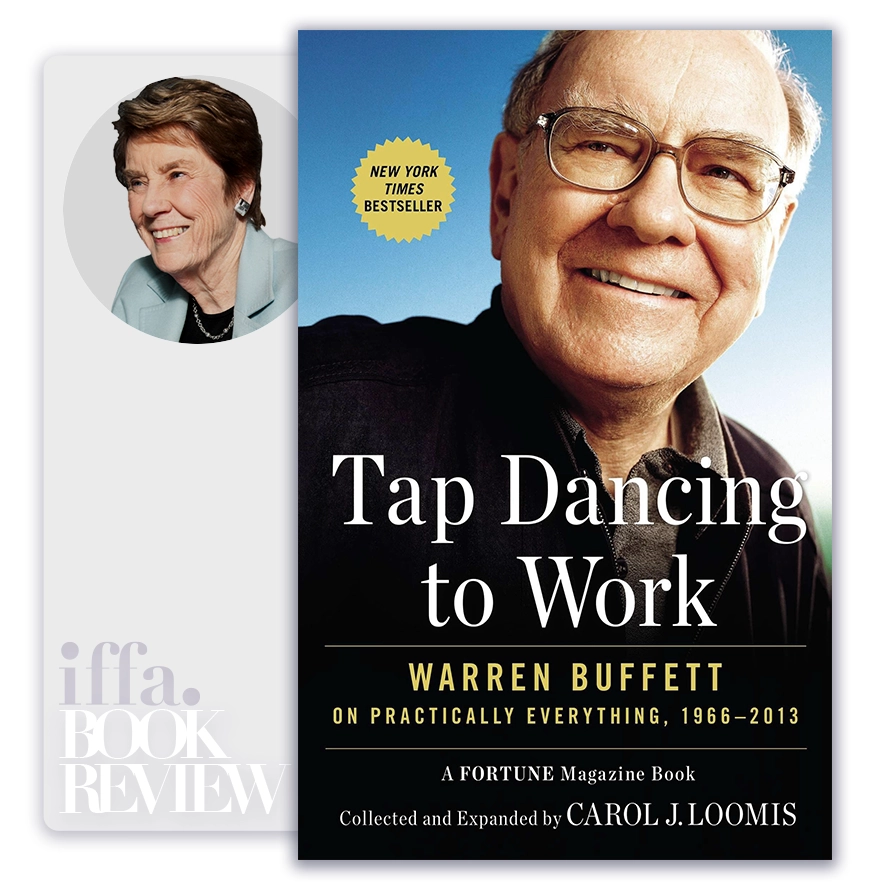
by Carol J. Loomis
Summary Overview:
Tap Dancing to Work remains relevant because it captures, in plain and disciplined language, how great decisions are made over long periods of uncertainty. Drawn primarily from Warren Buffett’s shareholder letters and essays curated by Carol J. Loomis, the book offers something rare: a first-principles view of leadership, governance, and capital allocation that has endured across cycles, crises, and changing business fashions.
For executives and leaders, this book matters not because it explains markets, but because it explains behavior—how leaders think when incentives are misaligned, when growth pressures distort judgment, and when success tempts organizations into complacency. Buffett’s writing, preserved and contextualized by Loomis, demonstrates that clarity of thinking and consistency of values are more powerful than complexity, charisma, or constant reinvention.
In an age where leadership is often associated with speed, visibility, and bold narratives, Tap Dancing to Work offers a counterbalance. It shows how long-term value is built quietly, through rational decision-making, patience, and a refusal to confuse activity with progress. For boards, executives, and long-term stewards of capital, the book functions as a strategic mirror, forcing readers to examine how they define success, measure performance, and exercise responsibility.
About The Author
Carol J. Loomis is one of the most respected financial journalists of her generation, known for her long association with Fortune magazine and her close professional relationship with Warren Buffett. Her authority lies in her ability to curate, contextualize, and preserve primary material without distorting its meaning, making complex ideas accessible while retaining their depth.
Core Idea:
The core idea of Tap Dancing to Work is that exceptional long-term leadership emerges from rational thinking, ethical consistency, and disciplined capital allocation, not from prediction or showmanship. Through Buffett’s own words, the book reveals a worldview in which businesses are treated as living systems, not financial abstractions, and leaders are seen as stewards rather than performers.
Underlying every essay is the belief that good judgment compounds when paired with integrity and patience. Buffett’s philosophy rejects short-term optimization and embraces durability—building organizations that can withstand errors, market shifts, and human bias. The book is not a guide to beating markets; it is a guide to thinking clearly when it matters most.
Sustainable success is built by leaders who think in decades, not quarters.
Key Concepts:
- Leadership as Stewardship, Not Performance
One of the book’s most consistent themes is that leadership is a responsibility to preserve and grow long-term value, not to impress audiences. Buffett’s tone is deliberately plain, reflecting a belief that substance matters more than style. For executives, this reframes leadership away from visibility and toward quiet accountability. - Capital Allocation as the CEO’s Core Job
Throughout the essays, Buffett returns to the idea that capital allocation is the most important responsibility of senior leadership. Whether reinvesting, acquiring, or returning capital, these decisions shape the organization’s future more than operational tactics. Poor allocation can erase years of operational excellence. - Incentives Shape Behavior More Than Strategy
Buffett repeatedly shows how compensation systems and internal metrics influence behavior, often in unintended ways. The book illustrates how misaligned incentives lead rational people to make irrational decisions, highlighting the board’s critical role in designing structures that reinforce long-term thinking. - Accounting Reality Versus Economic Reality
A recurring insight is the difference between reported numbers and true economic performance. Buffett warns against relying solely on accounting optics, emphasizing cash generation, return on capital, and durability of earnings. Leaders who mistake appearance for reality expose their organizations to hidden risk. - Corporate Culture as a Strategic Asset
The essays reveal how Berkshire Hathaway’s decentralized, trust-based culture enables strong performance without heavy bureaucracy. Buffett treats culture not as a slogan, but as an operating system that governs decisions when rules are absent and oversight is limited. - Avoiding Complexity and Financial Engineering
Buffett’s skepticism toward unnecessary complexity runs throughout the book. He consistently argues that complex structures often exist to disguise risk or justify fees, not to create value. For executives, this reinforces the idea that simplicity is not naïve—it is protective. - Long-Term Relationships Over Transactional Thinking
Whether dealing with shareholders, managers, or acquisition targets, Buffett emphasizes trust and continuity. The book shows how reputation compounds, reducing friction and improving decision quality over time. This principle extends to partnerships, governance, and stakeholder relations. - Risk as Permanent Loss, Not Volatility
Rather than equating risk with price movement, Buffett defines risk as the possibility of permanent capital impairment. This reframing encourages leaders to focus on resilience, balance sheet strength, and downside protection rather than short-term fluctuations. - Rationality Under Pressure
Many essays reflect moments of market stress or corporate scandal. Buffett’s consistent response is calm analysis and adherence to principles. The lesson for leaders is that crises reveal the true quality of decision frameworks, not just character. - Enjoyment Rooted in Purpose
The title itself reflects Buffett’s attitude toward work: genuine enthusiasm grounded in purpose, not ego. This suggests that sustainable leadership energy comes from alignment with values, not from constant ambition or external validation.
The quality of judgment, reinforced by ethical consistency, ultimately outweighs intelligence or speed.
Executive Insights:
Tap Dancing to Work offers a philosophy of leadership that is grounded, ethical, and strategically conservative, yet remarkably effective over time. It demonstrates how organizations succeed not by chasing trends, but by consistently applying sound judgment across cycles.
For modern leaders, the book’s relevance lies in its resistance to noise. It argues that while tools, technologies, and markets change, human behavior, incentives, and error patterns remain constant. Leaders who understand this build institutions that endure.
Key strategic implications include:
- Long-term value depends more on capital discipline than operational intensity
- Governance systems must prioritize economic reality over reported performance
- Culture and incentives quietly determine strategic outcomes
- Simplicity and transparency reduce hidden risk
- Trust and reputation are compounding assets
Actionable Takeaways:
While the book avoids tactics, its principles translate into clear practical actions at the executive level.
- Align executive incentives with long-term value creation rather than short-term metrics
- Challenge complexity in strategy, financing, and reporting
- Assess leadership quality by decision process, not just outcomes
- Protect organizational culture as a strategic asset
- Define risk in terms of permanence, not volatility
- Build trust-based relationships that reduce friction over time
- Prioritize resilience and balance sheet strength
Final Thoughts:
Tap Dancing to Work is not simply a collection of essays; it is a coherent philosophy of leadership and judgment expressed through decades of real decisions. Its enduring power lies in its clarity—showing that sustainable success is built through patience, integrity, and disciplined thinking rather than constant action.
In a business environment often dominated by speed and spectacle, the book reminds leaders that lasting value is created by those who think calmly, act responsibly, and remain faithful to sound principles. The true lesson is not how to imitate Warren Buffett, but how to cultivate the temperament and judgment required for long-term leadership.
The ideas in this book go beyond theory, offering practical insights that shape real careers, leadership paths, and professional decisions. At IFFA, these principles are translated into executive courses, professional certifications, and curated learning events aligned with today’s industries and tomorrow’s demands. Discover more in our Courses.
Applied Programs

- Course Code : SBM-409
- Delivery : In-class / Virtual / Workshop
- Duration : 2-4 Days
- Venue: DUBAI HUB

- Course Code : PMA-613
- Delivery : In-class / Virtual / Workshop
- Duration : 3-5 Days
- Venue: DUBAI HUB
- Course Code : CIF-505
- Delivery : In-class / Virtual / Workshop
- Duration : 3-5 Days
- Venue: DUBAI HUB

- Course Code : CIF-512
- Delivery : In-class / Virtual / Workshop
- Duration : 2-4 Days
- Venue: DUBAI HUB
Related Books