
The Executive Summary of
Empire of AI
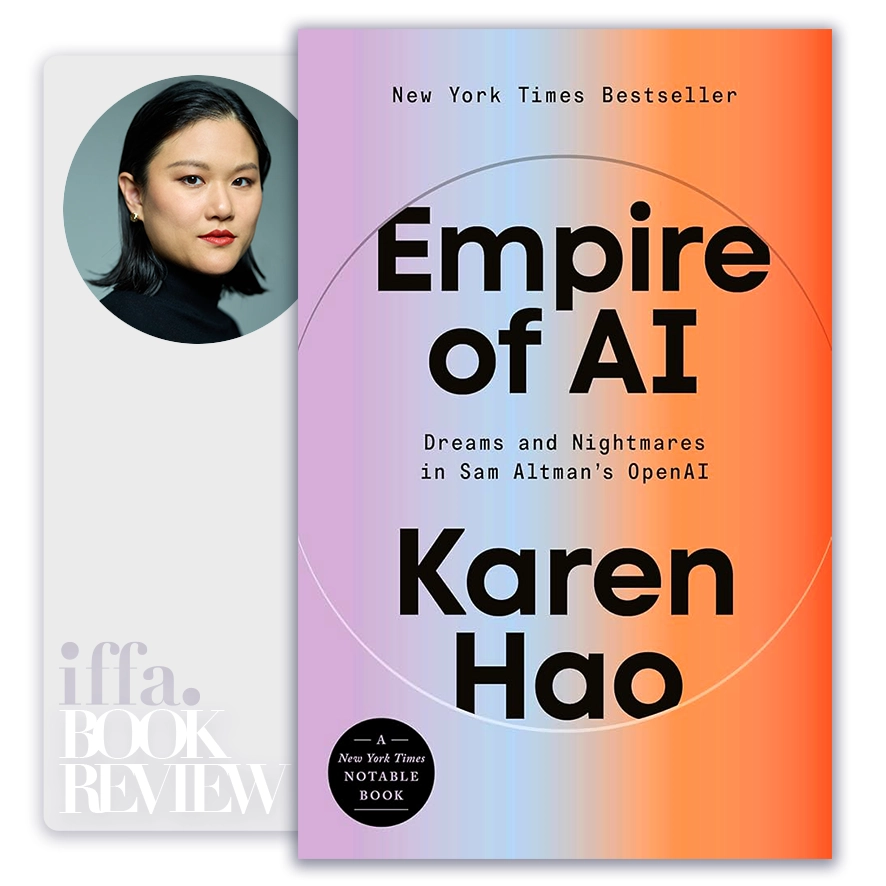
by Karen Hao
Summary Overview:
Empire of AI matters because it reframes artificial intelligence not as a neutral technological breakthrough, but as a new concentration of power with profound political, economic, and social consequences. While much of the public conversation around AI focuses on productivity gains, innovation, or existential risk, Hao directs attention to a more immediate and structural issue: who controls AI, who benefits from it, and who bears its costs.
As AI systems become foundational to economies, governance, and everyday life, decisions about data ownership, model deployment, labor, and infrastructure increasingly shape global inequality and institutional authority. Hao argues that AI is not merely transforming industries—it is reconfiguring power relations, often reinforcing existing hierarchies while presenting itself as inevitable progress.
For leaders, policymakers, and institutions, the book is a warning against technological naïveté. It shows that AI development is not an organic or evenly distributed process, but one driven by capital concentration, geopolitical competition, and opaque corporate incentives. Understanding these dynamics is essential for anyone responsible for long-term strategy, governance, or societal trust.
About The Author
Karen Hao is a technology journalist with deep expertise in artificial intelligence, labor, and digital governance. Her work is distinguished by combining technical literacy with investigative reporting, allowing her to expose the structural forces shaping AI development beyond marketing narratives and surface-level optimism.
Core Idea:
The core idea of Empire of AI is that artificial intelligence is becoming an imperial system—centralized, extractive, and asymmetrical in its distribution of power. Hao argues that today’s AI ecosystem mirrors historical empires: a small number of dominant actors control critical infrastructure, extract value from vast populations, and set the rules under which others must operate.
Rather than democratizing opportunity, AI often consolidates advantage. Data is extracted from users and workers, computational resources are monopolized by a few corporations and states, and decision-making authority is increasingly embedded in opaque systems beyond public accountability. The book challenges the assumption that AI progress is inherently beneficial, showing instead that outcomes depend on governance, incentives, and resistance to concentration.
AI is not just a technology, it is a system of power that reflects who controls data, labor, and infrastructure.
Key Concepts:
- AI as an Infrastructure of Power
Hao positions AI not as a product, but as infrastructure—akin to railways, energy grids, or financial systems. Control over this infrastructure grants disproportionate influence over markets, information, and behavior. Those excluded become dependent rather than empowered. - Data Extraction as a New Resource Economy
Data is treated as the raw material of AI empires. The book shows how personal data, public content, and human behavior are continuously harvested—often without meaningful consent—to fuel systems that primarily benefit centralized actors. - Labor Hidden Behind Automation Narratives
Contrary to popular narratives, AI is not purely automated. Hao exposes the vast, often invisible labor force—content moderators, data labelers, and low-paid contractors—who make AI systems functional. This labor is frequently outsourced, precarious, and psychologically damaging. - Compute Concentration and Barriers to Entry
Advanced AI development requires massive computational resources. This creates high barriers to entry, ensuring that only a few corporations and governments can meaningfully compete. Innovation becomes capital-dependent rather than idea-driven. - The Myth of Neutral Algorithms
Hao challenges the belief that algorithms are objective. AI systems encode the values, priorities, and blind spots of their creators and funders. Claims of neutrality often mask political and economic interests embedded in design choices. - Surveillance and Behavioral Control
The book explores how AI enables new forms of surveillance—by states and corporations alike. Predictive systems shape behavior through recommendation, scoring, and nudging, quietly shifting power away from individuals toward centralized systems. - Geopolitics and AI Arms Races
AI development is increasingly framed as a geopolitical contest. Hao shows how national security narratives justify secrecy, deregulation, and rapid deployment—often sidelining ethical concerns and public accountability. - Environmental and Resource Costs
Large-scale AI systems consume enormous amounts of energy and water. These environmental costs are rarely included in AI’s economic calculations, externalizing harm while celebrating efficiency gains. - Democratic Erosion and Accountability Gaps
As AI systems influence decisions about credit, employment, policing, and information access, democratic oversight weakens. Many systems operate beyond effective regulation, creating accountability vacuums. - Alternatives to Empire Thinking
The book does not reject AI outright. Instead, it explores alternative models—public-interest AI, cooperative data governance, transparency requirements—that could counterbalance concentration if pursued deliberately.
Without governance, AI scales inequality faster than it scales intelligence.
Executive Insights:
Empire of AI reframes artificial intelligence as a governance challenge before it is a technological one. Its insights suggest that organizations and governments adopting AI without questioning underlying power structures may inadvertently reinforce inequality, dependency, and public mistrust.
For leaders, the book highlights that AI strategy is inseparable from institutional legitimacy. Systems perceived as exploitative or opaque will face resistance, regulation, and reputational damage. Conversely, those that prioritize transparency, fairness, and accountability may gain long-term resilience.
Key strategic implications include:
- AI adoption redistributes power, not just efficiency
- Concentration increases systemic risk and dependency
- Labor and environmental costs must be treated as strategic factors
- Governance failures scale faster than technical failures
- Trust and legitimacy are competitive advantages in AI deployment
Actionable Takeaways:
The book suggests broad principles for responsible engagement with AI systems.
- Treat AI as a power system, not a neutral tool
- Question who controls data, models, and infrastructure
- Make labor, environmental, and social costs visible in AI decisions
- Demand transparency and accountability in high-impact systems
- Avoid over-dependence on concentrated AI providers
- Support governance frameworks that protect public interest
- Balance innovation speed with institutional trust and legitimacy
Final Thoughts:
Empire of AI is a necessary corrective to triumphalist narratives surrounding artificial intelligence. Its strength lies in revealing that AI’s greatest risks are not hypothetical future scenarios, but present-day concentrations of power operating without sufficient oversight.
The enduring insight of the book is clear and sobering: AI will not automatically serve humanity—it will serve those who shape its rules. Leaders who recognize this reality and act with foresight, restraint, and responsibility will be better positioned to ensure that AI becomes a tool for shared progress rather than a new empire built on extraction and exclusion.
The ideas in this book go beyond theory, offering practical insights that shape real careers, leadership paths, and professional decisions. At IFFA, these principles are translated into executive courses, professional certifications, and curated learning events aligned with today’s industries and tomorrow’s demands. Discover more in our Courses.
Applied Programs

- Course Code : SBM-409
- Delivery : In-class / Virtual / Workshop
- Duration : 2-4 Days
- Venue: DUBAI HUB

- Course Code : PMA-613
- Delivery : In-class / Virtual / Workshop
- Duration : 3-5 Days
- Venue: DUBAI HUB
- Course Code : CIF-505
- Delivery : In-class / Virtual / Workshop
- Duration : 3-5 Days
- Venue: DUBAI HUB

- Course Code : CIF-512
- Delivery : In-class / Virtual / Workshop
- Duration : 2-4 Days
- Venue: DUBAI HUB
Related Books