The Executive Summary of
The Origin of Wealth
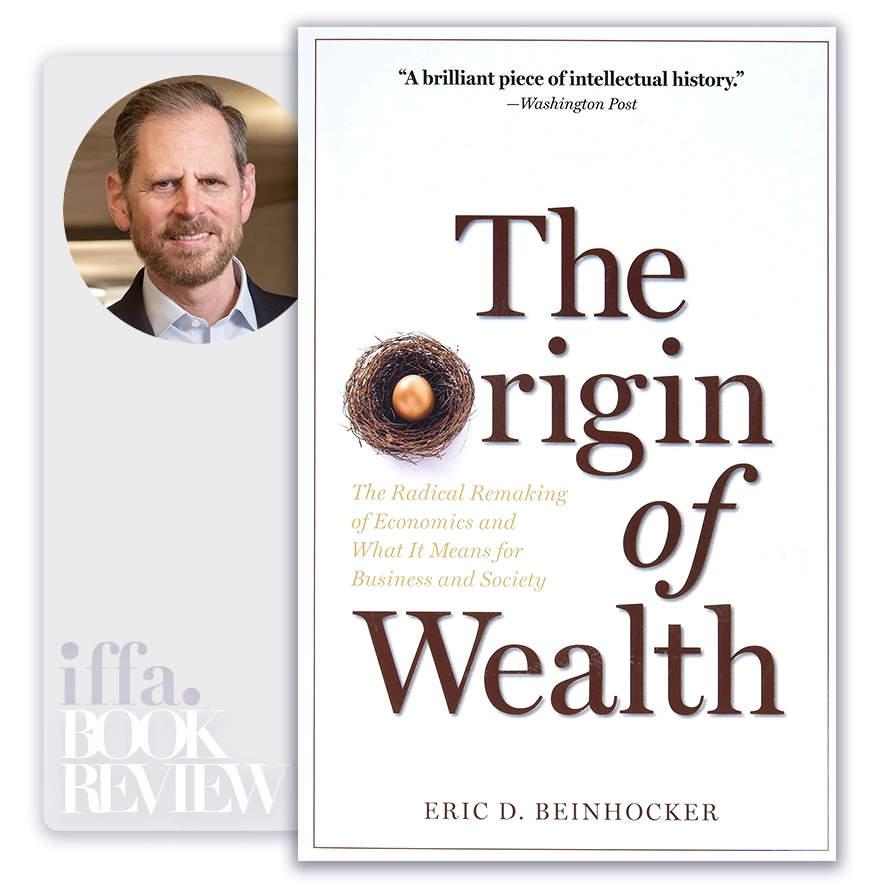
by Eric D. Beinhocker
Summary Overview:
For more than a century, economics has been taught as a discipline of equilibrium, efficiency, and rational choice. Markets are assumed to move toward balance, firms optimize, and individuals act as rational calculators. The Origin of Wealth dismantles this worldview. Eric Beinhocker argues that the traditional economic model is not merely incomplete—it is fundamentally wrong for explaining how wealth is actually created.
This book matters because today’s economy is defined by innovation, complexity, rapid change, and uncertainty. Digital platforms, global supply chains, financial crises, technological disruption, and climate transitions cannot be understood using static, equilibrium-based thinking. For executives, policymakers, investors, and strategists, The Origin of Wealth offers a radically more realistic framework: the economy is an evolving, adaptive system, governed by the same principles that shape biological evolution. Wealth is not discovered—it is created through experimentation, selection, and adaptation.
About The Author
Eric D. Beinhocker is an economist, complexity theorist, and former McKinsey partner, best known for integrating complexity science, evolutionary biology, and economics. He is also the founder of the Institute for New Economic Thinking at Oxford.
Beinhocker’s credibility lies in his ability to bridge theory and practice. He has advised governments, corporations, and institutions on strategy and economic policy while simultaneously challenging the intellectual foundations of modern economics. His work is particularly influential among leaders grappling with uncertainty, innovation, and systemic risk.
Core Idea:
At the heart of The Origin of Wealth is a bold and unifying thesis:
The economy is not a machine in equilibrium—it is a complex, evolving system that creates wealth through variation, selection, and amplification.
Beinhocker reframes wealth creation as an evolutionary process. Just as biological organisms evolve through trial and error, economic systems generate wealth by:
- Creating diverse ideas, technologies, and business models
- Testing them in competitive environments
- Scaling what works and discarding what doesn’t
In this view, markets are not optimization engines—they are search engines, constantly exploring possibilities.
Wealth is not allocated by markets; it is evolved by them.
Key Concepts:
- The Failure of Traditional Economics
Beinhocker critiques what he calls “Classical Economics”, which assumes:
- Rational agents
- Perfect information
- Stable preferences
- Equilibrium outcomes
These assumptions may simplify math—but they misrepresent reality.
An economy made of thinking, learning, adapting humans cannot be modeled as a static system. Real economies are dynamic, path-dependent, and unpredictable.
- The Economy as a Complex Adaptive System
Drawing from complexity science, Beinhocker describes the economy as:
- Nonlinear
- Emergent
- Adaptive
- History-dependent
Small changes can produce massive outcomes, while large interventions may have little effect.
In complex systems, cause and effect are rarely proportional. This explains:
- Financial bubbles and crashes
- Sudden technological dominance
- Unexpected market leaders
- Policy failures despite good intentions
- Wealth Comes from “Fit” Solutions
Beinhocker introduces the concept of “fitness”, borrowed from evolutionary biology.
Economic fitness refers to:
- How well a product, idea, or organization fits its environment
- Customer needs
- Technological constraints
- Regulatory conditions
- Cultural context
There is no single best solution—only solutions that fit better than others at a given time. As environments change, yesterday’s winners can become obsolete.
- Innovation Is the Engine of Wealth
Wealth growth is driven primarily by innovation, not capital accumulation alone.
Innovation emerges from:
- Experimentation
- Failure
- Diversity of ideas
- Decentralized decision-making
Most innovations fail—but progress depends on that failure rate. This explains why:
- Venture capital portfolios expect high failure
- Competitive markets outperform centralized planning
- Monopolies stagnate over time
- Variation, Selection, and Amplification
Beinhocker maps economic evolution to three core mechanisms:
- Variation – generating new ideas, products, and models
- Selection – market competition determines what survives
- Amplification – successful solutions scale rapidly
Economic progress requires waste in the short term to create value in the long term. Attempts to eliminate “inefficiency” often eliminate innovation.
- The Role of Institutions
Markets do not evolve in a vacuum. Institutions shape the evolutionary landscape.
Key institutions include:
- Property rights
- Legal systems
- Financial markets
- Education systems
- Governance frameworks
Institutions do not create wealth directly—they shape the search process that does. Bad institutions constrain experimentation; good ones expand it.
- Inequality as an Emergent Outcome
Beinhocker addresses inequality not as a moral failure, but as a natural outcome of evolutionary systems.
In winner-take-most environments:
- Small differences amplify
- Success compounds
- Wealth concentrates
Inequality emerges naturally in evolving systems—but must be managed deliberately.
Policy must balance:
- Incentives for innovation
- Social stability
- Long-term sustainability
- Why Central Planning Fails
Central planners struggle because:
- They cannot process enough information
- They cannot predict innovation
- They suppress variation
You cannot centrally plan discovery. This explains why:
- Command economies stagnate
- Over-regulation slows innovation
- Excessive optimization reduces adaptability
- Strategy as Evolutionary Search
For firms, strategy is not about finding the perfect plan—it is about running a better evolutionary process.
Effective strategies:
- Encourage experimentation
- Accept intelligent failure
- Scale winners quickly
- Adapt continuously
The best companies don’t predict the future—they evolve faster than competitors.
- Sustainability and the Future of Wealth
Beinhocker argues that future wealth creation must account for:
- Environmental constraints
- Resource limits
- Social cohesion
An economy that destroys its environment is not fit—it will be selected against.
Sustainable innovation is not optional; it is evolutionary necessity.
An economy made of thinking, learning, adapting humans cannot be modeled as a static system.
Executive Insights:
The Origin of Wealth fundamentally changes how leaders should think about growth, strategy, and policy.
Strategic Implications for Executives and Leaders:
- Stop optimizing for efficiency alone
- Design organizations for adaptability
- Encourage experimentation at scale
- Accept failure as a cost of progress
- Invest in learning speed, not certainty
- Build institutional trust and flexibility
Companies that pursue short-term optimization often sacrifice long-term fitness.
Actionable Takeaways:
For Executives and Organizations
- Create safe-to-fail experimentation environments
- Reward learning, not just success
- Decentralize decision-making
- Shorten feedback loops
- Scale proven innovations aggressively
- Balance efficiency with resilience
For Investors and Strategists
- Expect nonlinear outcomes
- Diversify across ideas, not just assets
- Look for evolutionary advantage, not equilibrium
- Value adaptability over static strength
Final Thoughts:
The Origin of Wealth is a foundational reframing of how prosperity emerges. Eric Beinhocker replaces the illusion of economic certainty with a far more powerful truth: wealth is created through evolution, not equilibrium.
In a world defined by uncertainty, disruption, and accelerating change, the winners will not be those who optimize the present—but those who build systems capable of discovering the future.
Wealth is not found. It is evolved—through diversity, experimentation, and relentless adaptation.
The ideas in this book go beyond theory, offering practical insights that shape real careers, leadership paths, and professional decisions. At IFFA, these principles are translated into executive courses, professional certifications, and curated learning events aligned with today’s industries and tomorrow’s demands. Discover more in our Courses.
Applied Programs

- Course Code : SBM-409
- Delivery : In-class / Virtual / Workshop
- Duration : 2-4 Days
- Venue: DUBAI HUB

- Course Code : PMA-613
- Delivery : In-class / Virtual / Workshop
- Duration : 3-5 Days
- Venue: DUBAI HUB
- Course Code : CIF-505
- Delivery : In-class / Virtual / Workshop
- Duration : 3-5 Days
- Venue: DUBAI HUB

- Course Code : CIF-512
- Delivery : In-class / Virtual / Workshop
- Duration : 2-4 Days
- Venue: DUBAI HUB
Related Books