The Executive Summary of
Our Dollar, Your Problem
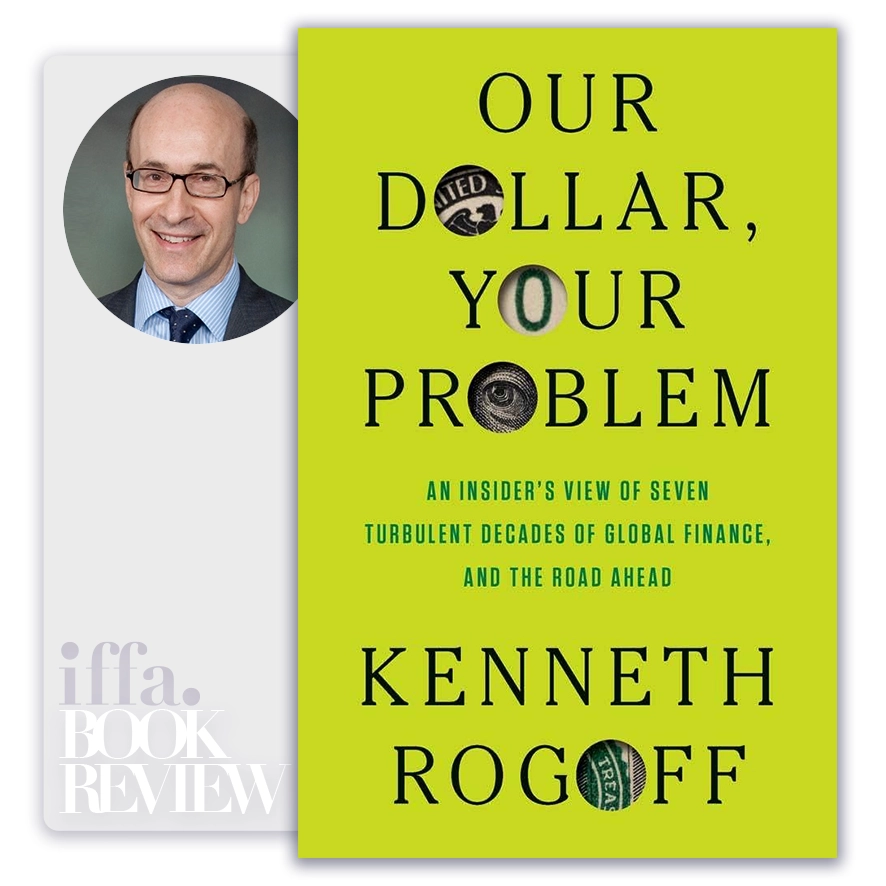
by Kenneth Rogoff
Summary Overview:
For decades, the U.S. dollar has served as the undisputed backbone of the global financial system—the dominant reserve currency, the default medium for trade, and the safe haven in times of crisis. Our Dollar, Your Problem confronts a growing and uncomfortable question: what happens to the world—and to the United States—when that dominance is no longer absolute? Kenneth Rogoff argues that the era of effortless dollar supremacy is entering a more fragile, contested phase.
This book matters because currency power is not an abstract monetary issue—it is a geopolitical, economic, and strategic force. Dollar dominance shapes interest rates, sanctions power, global capital flows, and crisis management. For policymakers, central bankers, investors, sovereign funds, and global executives, Our Dollar, Your Problem provides a sober, historically grounded framework for understanding how financial power shifts gradually, painfully, and often unexpectedly. It is a warning against complacency and a guide to navigating a world of monetary fragmentation and rising systemic risk.
About The Author
Kenneth Rogoff is one of the world’s most respected macroeconomists, a professor at Harvard University, and former Chief Economist of the International Monetary Fund (IMF). He has advised governments and central banks across advanced and emerging economies.
Rogoff’s authority comes from a rare combination of academic rigor, policy experience, and historical depth. He has studied financial crises, debt cycles, inflation, and currency regimes for decades—making his perspective uniquely suited to analyze the long arc of monetary power and its political consequences.
Core Idea:
At the heart of Our Dollar, Your Problem lies a clear and unsettling insight:
The U.S. dollar will not collapse suddenly—but its dominance will erode in ways that reshape global finance, geopolitics, and economic stability.
Rogoff argues that reserve currency dominance is never permanent. History shows that leading currencies—such as the British pound—lose influence not through dramatic collapse, but through gradual diversification, policy mistakes, geopolitical shifts, and institutional decay. The dollar’s position remains strong, but it is increasingly strained by debt, political polarization, weaponization of finance, and the rise of alternative systems.
The central paradox of the book is captured in its title: the dollar’s dominance benefits the United States—but often creates instability, dependence, and vulnerability for everyone else.
Reserve currency status is not earned once, it must be continuously maintained.
Key Concepts:
- Why the Dollar Dominates
The dollar’s global role rests on multiple reinforcing pillars:
- The size and openness of the U.S. economy
- Deep, liquid financial markets
- Rule of law and contract enforcement
- Military and geopolitical power
- Network effects (everyone uses the dollar because everyone uses the dollar)
Reserve currency status is not earned once—it must be continuously maintained. Rogoff emphasizes that no single rival can easily replace the dollar—but many small shifts together can weaken it.
- The “Exorbitant Privilege”—and Its Cost
Dollar dominance gives the United States extraordinary advantages:
- Lower borrowing costs
- Ability to run persistent deficits
- Powerful financial sanctions
- Crisis response flexibility
However, Rogoff highlights the hidden costs:
- Chronic trade imbalances
- Asset bubbles driven by global capital inflows
- Political complacency around debt
- Overconfidence in monetary immunity
What feels like privilege can quietly become dependence.
- Weaponization of the Dollar
One of the book’s most urgent themes is the use of the dollar as a geopolitical weapon. Sanctions, financial exclusion, and payment restrictions have become central tools of foreign policy.
While effective in the short term, Rogoff warns that:
- Excessive use incentivizes alternatives
- Targeted countries accelerate de-dollarization
- Neutral countries seek hedging mechanisms
This does not end dollar dominance—but it encourages fragmentation.
- The Rise of Currency Multipolarity
Rather than a single replacement currency, Rogoff predicts a multipolar monetary world, where:
- The euro plays a regional role
- China’s renminbi expands cautiously
- Smaller currencies gain niche influence
- Digital currencies alter settlement systems
This fragmentation reduces efficiency but increases strategic optionality for nations seeking autonomy from U.S. financial influence.
- Debt, Inflation, and Fiscal Stress
Rogoff places heavy emphasis on public debt dynamics. The United States carries historically high debt levels, and while inflation temporarily reduces real debt burdens, it:
- Undermines credibility
- Raises long-term interest rates
- Encourages capital diversification
Reserve currencies fail slowly—then suddenly under stress. Fiscal discipline matters not because collapse is imminent, but because credibility erosion compounds quietly.
- Financial Repression and Hidden Taxation
The book explores how governments manage high debt through:
- Low or negative real interest rates
- Capital controls
- Regulatory pressure on banks and savers
These tools function as stealth taxes, redistributing wealth and suppressing alternatives. Rogoff argues that such practices can stabilize systems temporarily—but at the cost of trust and efficiency.
- Emerging Markets: Living with “Our Dollar”
For emerging economies, the dollar creates persistent challenges:
- Currency mismatches
- Debt vulnerability
- Capital flow volatility
- Limited monetary sovereignty
Hence the title: Our Dollar, Your Problem. Dollar cycles driven by U.S. policy often destabilize economies with little control over the source of shocks.
- Digital Currencies and the Future of Money
Rogoff treats cryptocurrencies and central bank digital currencies (CBDCs) with measured realism. While unlikely to dethrone the dollar directly, they:
- Reduce transaction friction
- Increase state surveillance potential
- Enable alternative payment rails
Digital innovation accelerates monetary experimentation, but does not eliminate the need for institutional trust.
- No Sudden Collapse—But No Free Pass
The book strongly rejects apocalyptic narratives of sudden dollar collapse. Instead, Rogoff emphasizes:
- Gradual diversification
- Higher borrowing costs over time
- Reduced sanction effectiveness
- More frequent financial instability
The danger is not replacement—it is erosion without preparation.
Reserve currencies fail slowly, then suddenly under stress.
Executive Insights:
Our Dollar, Your Problem reframes global finance as a system under slow structural stress, not imminent breakdown. For leaders, it demands a shift from binary thinking (dominant vs. replaced) to probabilistic risk management.
Strategic Implications for Leaders and Policymakers:
- Currency dominance is a policy outcome, not a birthright
- Weaponization accelerates diversification
- Debt tolerance has limits—even for reserve issuers
- Fragmentation raises systemic risk
- Trust and institutions matter more than technology
Corporations and investors must adapt to a world where currency risk, capital controls, and political finance are structural features, not anomalies.
Actionable Takeaways:
The book offers practical guidance for navigating a shifting monetary order.
For Governments and Central Banks:
- Preserve institutional credibility
- Avoid overuse of financial sanctions
- Strengthen fiscal discipline
- Prepare for multipolar currency coordination
- Balance innovation with trust
For Executives and Investors:
- Diversify currency exposure
- Stress-test funding and liquidity assumptions
- Monitor political and monetary risk together
- Plan for capital flow volatility
- Understand that “safe assets” are conditional
For Emerging Economies:
- Reduce dollar mismatches
- Build local currency markets
- Strengthen macroprudential defenses
- Develop strategic optionality
Final Thoughts:
Our Dollar, Your Problem is neither alarmist nor complacent—it is strategically realistic. Kenneth Rogoff delivers a clear message: the dollar’s dominance will persist, but on less forgiving terms. The future belongs not to those who predict collapse, but to those who prepare for gradual change, rising complexity, and institutional stress.
In a fragmented world, monetary power endures only when credibility, restraint, and foresight travel together.
The ideas in this book go beyond theory, offering practical insights that shape real careers, leadership paths, and professional decisions. At IFFA, these principles are translated into executive courses, professional certifications, and curated learning events aligned with today’s industries and tomorrow’s demands. Discover more in our Courses.
Applied Programs

- Course Code : SBM-409
- Delivery : In-class / Virtual / Workshop
- Duration : 2-4 Days
- Venue: DUBAI HUB

- Course Code : PMA-613
- Delivery : In-class / Virtual / Workshop
- Duration : 3-5 Days
- Venue: DUBAI HUB
- Course Code : CIF-505
- Delivery : In-class / Virtual / Workshop
- Duration : 3-5 Days
- Venue: DUBAI HUB

- Course Code : CIF-512
- Delivery : In-class / Virtual / Workshop
- Duration : 2-4 Days
- Venue: DUBAI HUB
Related Books