The Executive Summary of
The Ascent of Money
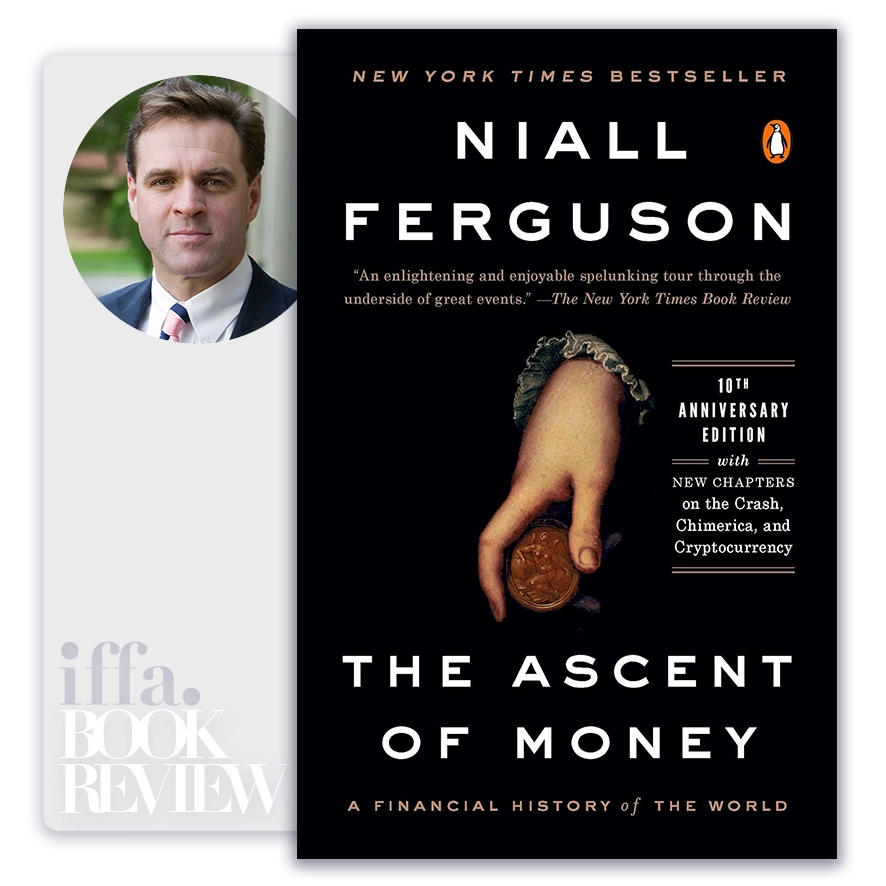
by Niall Ferguson
Summary Overview:
Money is often treated as a technical tool—neutral, mechanical, and abstract. The Ascent of Money challenges this assumption by showing that financial systems are among the most powerful forces shaping civilizations, empires, wars, inequality, and innovation. Niall Ferguson reframes financial history not as a side story to politics or economics, but as the central narrative of human progress and collapse.
This book matters because modern leadership operates inside systems built over centuries: credit, banking, bonds, insurance, equity markets, and globalization. When these systems function well, they enable prosperity and innovation; when they fail, they unleash crises with global consequences. Ferguson demonstrates that understanding money is not optional for leaders—it is a prerequisite for understanding power, stability, and risk. For executives, policymakers, and investors, this book offers a strategic lens on why financial systems rise, spread, and sometimes implode.
About The Author
Niall Ferguson is a renowned historian and economist known for connecting financial systems, political power, and global history. His work spans empires, wars, institutions, and markets, with a particular focus on how finance shapes geopolitical outcomes.
Ferguson’s authority lies in his ability to translate centuries of financial evolution into patterns relevant to modern decision-makers, combining historical depth with contemporary relevance.
Core Idea:
The central thesis of The Ascent of Money is ambitious and compelling:
The evolution of financial systems—not just technology or military power—has been the decisive driver of human progress and global dominance.
Ferguson argues that societies that developed sophisticated financial institutions—credit markets, public debt, equity ownership, and risk-sharing mechanisms—outperformed those that relied on extraction, conquest, or centralized control. Money, when organized intelligently, becomes a force multiplier for innovation, growth, and resilience.
At the same time, the book emphasizes that finance is inherently fragile: when trust breaks, the entire system is at risk.
Money is not metal or paper: it is trust, institutionalized.
Key Concepts:
- Money as Memory and Trust
Ferguson begins by reframing money not merely as currency, but as a system of trust and record-keeping.
Money functions because:
- People believe it will be accepted tomorrow
- Institutions protect its integrity
- Contracts are enforceable
Money is not metal or paper—it is trust, institutionalized. This insight explains why financial collapse is often psychological before it is mathematical.
- Credit and Debt as Engines of Growth
The book traces the rise of credit as one of humanity’s most powerful innovations.
Key insights include:
- Credit allows future income to fund present investment
- Debt enables states to wage war and build infrastructure
- Bond markets distribute risk across society
Ferguson shows that nations that learned to borrow credibly—notably Britain—gained enormous advantages over rivals that relied on taxation or plunder.
- Bonds, States, and the Rise of Empires
Public debt markets transformed state power. Governments that could issue bonds at low interest:
- Funded wars more sustainably
- Built long-term institutions
- Outlasted fiscally weaker rivals
Financial credibility often matters more than military strength. This explains why financial innovation often precedes geopolitical dominance.
- Banking: From Goldsmiths to Global Giants
Banks evolved from simple intermediaries into systemic institutions that:
- Allocate capital
- Create money through lending
- Concentrate risk
Ferguson shows that banking crises are not aberrations—they are structural features of leveraged systems. The tension between profitability and stability is permanent.
- Equity Markets and the Democratization of Capital
The rise of stock markets allowed:
- Risk-sharing at scale
- Long-term investment in innovation
- Ownership beyond elites
Joint-stock companies financed:
- Exploration
- Industrialization
- Infrastructure
Yet equity markets also introduced:
- Speculation
- Bubbles
- Volatility
Capitalism advances by sharing risk—but pays the price in cycles of boom and bust.
- Insurance: Taming Uncertainty
Insurance emerged as a mechanism to:
- Pool risk
- Enable entrepreneurship
- Reduce fear of catastrophe
By transferring risk, insurance allowed:
- Long-distance trade
- Industrial expansion
- Urbanization
However, Ferguson notes that insurance can also create moral hazard, encouraging risk-taking under the illusion of protection.
- Globalization of Finance
The book highlights how financial capital became increasingly global—flowing across borders faster than regulation could follow.
Global finance:
- Accelerated growth
- Increased interdependence
- Amplified contagion during crises
Global finance spreads prosperity—and panic—at unprecedented speed.
This interconnectedness explains why local shocks now have global consequences.
- Inequality and the Distribution of Financial Power
Ferguson addresses the uncomfortable reality that financial systems often concentrate wealth and power.
Key observations:
- Financial access determines opportunity
- Inequality can destabilize societies
- Political backlash often follows financial excess
Finance can be both a ladder and a barrier, depending on institutional design.
- Crises as Features, Not Bugs
Financial crises recur because:
- Leverage accumulates during good times
- Confidence breeds complacency
- Innovation outpaces understanding
Ferguson emphasizes that crises are not failures of capitalism alone—but corrections that expose underlying fragility. Every financial innovation eventually produces its own crisis.
- The Illusion of Financial Finality
A recurring warning in the book is against believing that any system represents the “end of history.”
No matter how advanced:
- Models fail
- Institutions decay
- Incentives distort behavior
Financial evolution is cyclical, not linear.
Financial credibility often matters more than military strength.
Executive Insights:
The Ascent of Money reframes finance as strategic infrastructure, not technical detail. It shows that leaders who misunderstand finance misunderstand power itself.
Strategic Implications for Leaders and Boards:
- Financial systems shape geopolitical outcomes
- Trust is the core asset of finance
- Leverage amplifies both success and failure
- Innovation without governance breeds crisis
- Globalization increases both opportunity and fragility
- Inequality is a systemic risk factor
- Financial literacy is leadership literacy
Actionable Takeaways:
The lessons of The Ascent of Money apply across corporate strategy, policy, and investment.
Practical Actions for Executives and Decision-Makers:
- Treat finance as strategic capability, not back-office function
- Monitor leverage and trust indicators
- Design incentives aligned with long-term stability
- Diversify funding sources and risk exposure
- Prepare for financial cycles—not just growth
- Understand historical patterns before making structural bets
- Balance innovation with institutional safeguards
- Anticipate political and social reactions to financial outcomes
Final Thoughts:
The Ascent of Money reveals that financial systems are among humanity’s greatest inventions—and its most dangerous. They enable prosperity, innovation, and global cooperation, yet repeatedly generate instability when confidence outruns discipline.
Niall Ferguson’s ultimate message is neither celebratory nor cynical—it is realist. Finance is not inherently good or evil; it is powerful. Those who understand it can shape the future. Those who ignore it are shaped by it.
Money is the story of how humans learned to bet on the future—and live with the consequences when those bets go wrong.
For modern leaders, the lesson is enduring:
To lead in the modern world is to understand finance—not just as numbers, but as history, psychology, and power combined.
The ideas in this book go beyond theory, offering practical insights that shape real careers, leadership paths, and professional decisions. At IFFA, these principles are translated into executive courses, professional certifications, and curated learning events aligned with today’s industries and tomorrow’s demands. Discover more in our Courses.
Applied Programs

- Course Code : SBM-409
- Delivery : In-class / Virtual / Workshop
- Duration : 2-4 Days
- Venue: DUBAI HUB

- Course Code : PMA-613
- Delivery : In-class / Virtual / Workshop
- Duration : 3-5 Days
- Venue: DUBAI HUB
- Course Code : CIF-505
- Delivery : In-class / Virtual / Workshop
- Duration : 3-5 Days
- Venue: DUBAI HUB

- Course Code : CIF-512
- Delivery : In-class / Virtual / Workshop
- Duration : 2-4 Days
- Venue: DUBAI HUB
Related Books