
The Executive Summary of
Maritime Economics
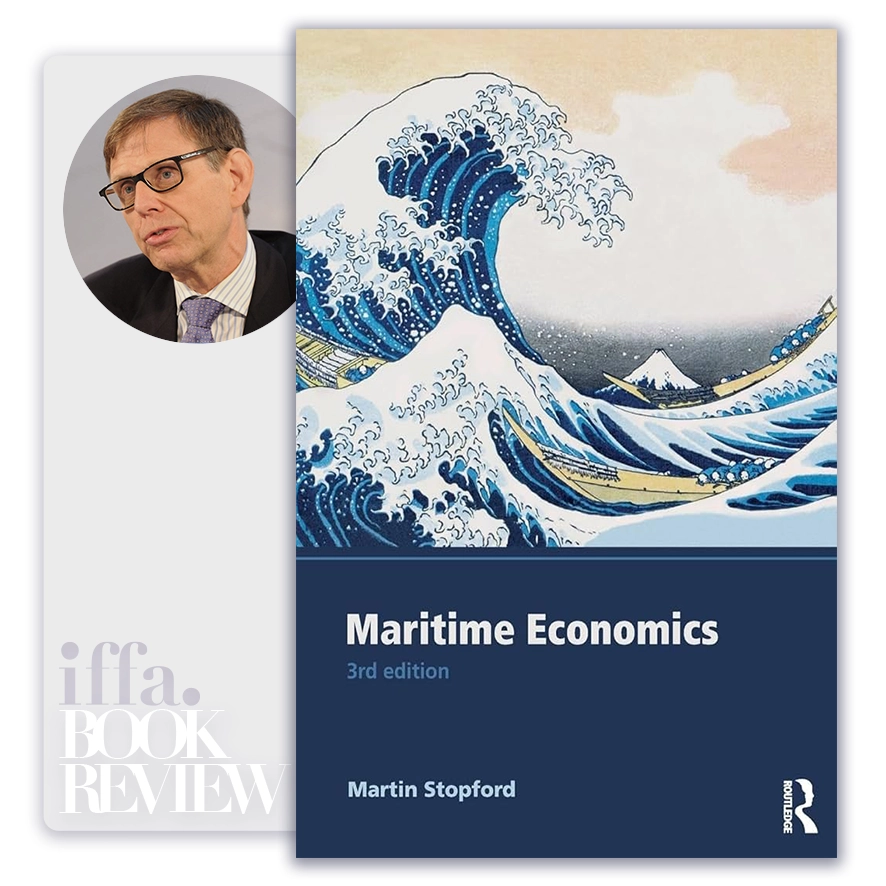
by Martin Stopford
Summary Overview:
More than 90% of global trade by volume moves by sea, yet shipping remains one of the least intuitively understood industries in the global economy. Maritime Economics explains why shipping markets behave in ways that often seem irrational—extreme volatility, long cycles, sudden collapses, and unexpected booms—and why traditional economic logic frequently fails to predict maritime outcomes.
This book matters because shipping is not just a transport service—it is a capital-intensive, cyclical, risk-exposed economic system where decisions made today may only bear fruit a decade later. Martin Stopford provides the most authoritative framework for understanding how supply, demand, costs, regulation, and finance interact in shipping markets. For shipowners, charterers, ports, investors, and policymakers, Maritime Economics is not merely an academic reference—it is a strategic survival manual for navigating one of the world’s most unforgiving industries.
About The Author
Martin Stopford is widely regarded as the world’s leading authority on shipping economics. He is a former shipbroker, maritime consultant, and long-time analyst of global shipping markets.
Stopford’s credibility comes from his ability to combine: Economic theory, Industry practice, Long-term historical data. His work bridges the gap between academic economics and the real-world decision-making challenges faced by shipowners and maritime investors.
Core Idea:
The central thesis of Maritime Economics is fundamental and enduring:
Shipping markets are governed by long-term cycles driven by the interaction of volatile demand and slow, capital-heavy supply.
Unlike most industries:
- Demand can change rapidly due to trade, geopolitics, or economic shocks
- Supply responds slowly due to shipbuilding lead times of 2–4 years
- Assets are expensive, mobile, and long-lived
- Entry and exit are difficult and delayed
This structural mismatch explains why shipping is inherently cyclical, unstable, and risky—yet also capable of extraordinary returns for those who understand its dynamics.
In shipping, survival often matters more than profitability.
Key Concepts:
- The Shipping Market as a System
Stopford frames shipping as an interconnected system comprising:
- Freight markets
- Shipbuilding markets
- Sale & purchase markets
- Demolition markets
These markets interact continuously.
Shipping markets cannot be understood in isolation—each market drives and corrects the others.
Strategic decisions must therefore consider system-wide consequences, not just spot freight rates.
- Demand for Sea Transport
Demand is derived—not created by shipping itself.
It depends on:
- World economic growth
- Industrial production
- Energy consumption
- Trade patterns
- Distance between production and consumption
Shipping demand is measured in ton-miles, not just cargo volume.
Distance matters as much as volume in determining shipping demand.
Globalization, reshoring, and energy transition all reshape ton-mile demand—even when cargo volumes remain stable.
- Supply of Shipping Services
Shipping supply is determined by:
- Fleet size
- Ship productivity
- Speed
- Port efficiency
- Regulations
Critically, fleet supply is highly inelastic in the short term.
Ships already built must trade—even at loss-making rates—because:
- Fixed costs dominate
- Cash flow matters more than profit in downturns
In shipping, survival often matters more than profitability.
- Freight Rate Formation
Freight rates are set at the margin:
- When ships are plentiful → rates collapse
- When ships are scarce → rates spike
Small imbalances between supply and demand can cause extreme rate volatility.
Stopford explains why:
- Freight rates do not track costs
- Rates are driven by market pressure, not fairness
- Expectations amplify volatility
Callout Insight:
Freight rates are prices of scarcity, not prices of service.
- The Shipping Cycle
One of the book’s most important contributions is the shipping cycle model, typically lasting 7–12 years.
The four phases:
- Trough – Low rates, high scrapping
- Recovery – Demand improves, rates stabilize
- Peak – High rates, optimism, heavy ordering
- Collapse – Oversupply, falling rates, losses
The seeds of the next crisis are always planted at the peak.
Understanding this cycle is essential for:
- Asset timing
- Fleet expansion
- Risk management
- Shipbuilding and Asset Risk
Ships are:
- Extremely capital-intensive
- Long-lived (20–30 years)
- Ordered during optimism
- Delivered during downturns
This creates systemic oversupply.
Ship prices fluctuate dramatically:
- Newbuild prices rise with demand
- Second-hand values collapse in downturns
- Asset values can fall faster than freight rates
In shipping, asset timing matters more than operational efficiency.
- Costs and Economies of Scale
Stopford analyzes operating costs:
- Capital costs
- Fuel
- Manning
- Maintenance
- Port charges
While economies of scale exist, they are:
- Limited by port infrastructure
- Offset by operational rigidity
- Vulnerable to regulatory change
Bigger ships reduce unit costs—but increase financial and market risk.
- Shipping Finance and Risk
Shipping finance is uniquely risky due to:
- Earnings volatility
- Asset price swings
- High leverage
- Cyclical downturns
Stopford shows how:
- Banks amplify cycles through lending behavior
- Debt becomes dangerous in downturns
- Equity investors demand high returns for volatility
Shipping is a cash-flow business—not a balance-sheet business.
- Regulation and Market Distortion
Regulation shapes shipping economics through:
- Safety standards
- Environmental rules
- Emission controls
- Trade policy
While regulation raises costs, it can also:
- Remove excess capacity
- Accelerate scrapping
- Reshape competitive balance
IMO regulations are now core economic drivers, not side constraints.
- Ports, Logistics, and Productivity
Port efficiency affects:
- Voyage duration
- Fleet productivity
- Effective supply
Congestion can:
- Raise freight rates artificially
- Reduce effective capacity
- Shift trade patterns
A slow port is equivalent to removing ships from the fleet.
The seeds of the next crisis are always planted at the peak.
Executive Insights:
Maritime Economics reframes shipping as a capital-cycle business, not a transport utility.
Strategic Implications for Shipping Leaders:
- Timing beats scale
- Cycles are structural, not accidental
- Cash flow matters more than accounting profit
- Leverage amplifies both success and failure
- Expect volatility—design for it
- Asset strategy is core strategy
- Regulation is a market force
- Operational excellence cannot overcome bad timing
Actionable Takeaways:
Stopford’s framework is directly applicable across shipping sectors.
Practical Actions for Executives and Investors:
- Track fleet supply, not just freight rates
- Time asset purchases counter-cyclically
- Avoid over-ordering at market peaks
- Manage leverage conservatively
- Plan for multi-year downturns
- Integrate regulatory forecasting into strategy
- Optimize fleet flexibility
- Treat ports and logistics as capacity levers
- Design survival strategies—not just growth plans
Final Thoughts:
Maritime Economics is the definitive guide to understanding why shipping markets behave the way they do—and why many intelligent players still fail. Martin Stopford shows that success in shipping does not come from optimism, scale, or efficiency alone, but from discipline, timing, and respect for cycles.
The book’s ultimate lesson is sobering and empowering:
Shipping rewards those who understand volatility—and destroys those who deny it.
For leaders operating in global trade, energy transport, and logistics, this book offers a timeless truth:
The sea may be unpredictable—but shipping markets are not random. Those who learn their structure can survive—and occasionally thrive—where others do not.
The ideas in this book go beyond theory, offering practical insights that shape real careers, leadership paths, and professional decisions. At IFFA, these principles are translated into executive courses, professional certifications, and curated learning events aligned with today’s industries and tomorrow’s demands. Discover more in our Courses.
Applied Programs

- Course Code : SBM-409
- Delivery : In-class / Virtual / Workshop
- Duration : 2-4 Days
- Venue: DUBAI HUB
- Course Code : PMA-613
- Delivery : In-class / Virtual / Workshop
- Duration : 3-5 Days
- Venue: DUBAI HUB
- Course Code : CIF-505
- Delivery : In-class / Virtual / Workshop
- Duration : 3-5 Days
- Venue: DUBAI HUB

- Course Code : CIF-512
- Delivery : In-class / Virtual / Workshop
- Duration : 2-4 Days
- Venue: DUBAI HUB
Related Books