The Executive Summary of
The Warren Buffett Way
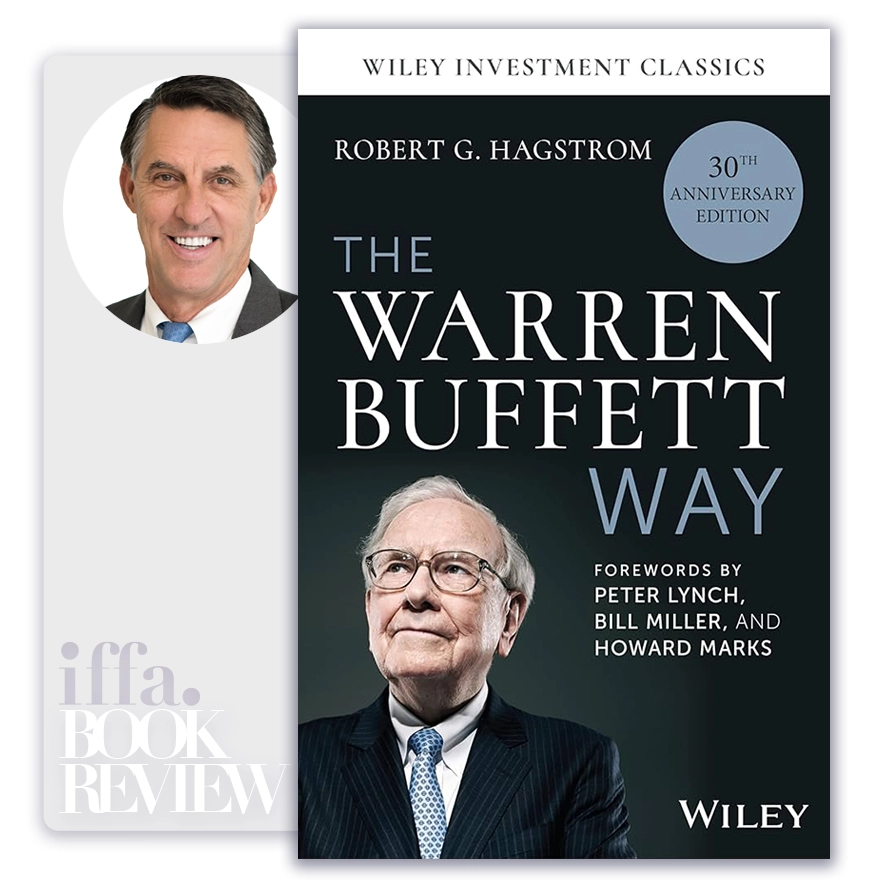
by Robert G. Hagstrom
Summary Overview:
In financial markets crowded with complex models, constant forecasts, and rapidly shifting narratives, The Warren Buffett Way stands out for one reason: it returns investing to first principles. Rather than chasing trends or engineering sophisticated strategies, the book explains how extraordinary results can be achieved through disciplined thinking, rational behavior, and unwavering focus on fundamentals. Its relevance has only increased in an era of volatility, algorithmic trading, and short-term performance pressure.
This book matters because it translates the philosophy of Warren Buffett into a clear, teachable framework. Hagstrom does not mythologize Buffett as an unrepeatable genius; instead, he demonstrates that Buffett’s success stems from a coherent system of beliefs about business, markets, and human behavior. For executives, investors, board members, and long-term capital allocators, The Warren Buffett Way offers a roadmap for making better decisions—not just in investing, but in leadership and strategy.
About The Author
Robert G. Hagstrom is a respected investment strategist, portfolio manager, and author who has spent decades studying Buffett’s approach and applying it in professional asset management. Unlike biographers, Hagstrom focuses on process rather than personality, distilling Buffett’s thinking into principles that can be understood, evaluated, and practiced.
His credibility lies in synthesis. Hagstrom bridges academic finance, behavioral insight, and real-world investing, making The Warren Buffett Way one of the most practical interpretations of Buffett’s philosophy available to serious practitioners.
Core Idea:
At the heart of The Warren Buffett Way lies a powerful and deceptively simple proposition:
Superior long-term investment results come from buying outstanding businesses at sensible prices and holding them patiently.
Buffett’s approach rejects market timing, speculation, and excessive diversification. Instead, it is built on:
- Deep understanding of business economics
- Rational assessment of value
- Discipline in capital allocation
- Emotional control under market pressure
The book shows that Buffett’s edge does not come from predicting markets, but from thinking differently about risk, value, and time. His strategy aligns investing with business ownership rather than trading—transforming stocks from symbols on a screen into stakes in real enterprises.
The most powerful investment advantage is not superior forecasting, but disciplined thinking combined with patience and long-term focus.
Key Concepts:
- Business-Driven Investing: Seeing Stocks as Companies
One of the book’s foundational contributions is its insistence that investing begins with understanding the business itself. Hagstrom explains that Buffett evaluates companies as if he were buying the entire enterprise, not a tradable asset. This mindset shifts attention away from short-term price movements and toward durable competitive advantages, cash generation, and management quality.
By grounding investment decisions in business fundamentals, Buffett avoids reacting to market noise. The book reinforces that markets fluctuate far more than underlying business value, and that long-term investors are rewarded for focusing on the latter.
- The Circle of Competence: Knowing What Not to Do
A recurring theme in The Warren Buffett Way is the importance of intellectual boundaries. Buffett does not attempt to understand every industry or opportunity. Instead, he operates within a clearly defined circle of competence—areas where he possesses deep, durable understanding.
Hagstrom emphasizes that this principle is not about limitation, but about risk control. Most investment mistakes occur not because people misunderstand known businesses, but because they venture into unfamiliar territory. Knowing what to avoid becomes as important as knowing what to pursue.
- Economic Moats and Sustainable Advantage
Central to Buffett’s philosophy is the concept of the economic moat—the structural advantage that allows a company to protect its profits from competition over long periods. Hagstrom details how Buffett looks for businesses with:
- Strong brand power
- Cost advantages
- Network effects
- High switching costs
- Regulatory or structural barriers
These moats allow companies to compound value steadily, reducing reliance on constant reinvention. For executives, this perspective extends beyond investing into strategy: sustainable advantage, not short-term performance, defines enduring success.
- Management Quality and Capital Allocation
The book places significant emphasis on leadership—not charisma or vision, but integrity, rationality, and capital discipline. Buffett prefers managers who think like owners, allocate capital wisely, and resist empire-building.
Hagstrom shows that capital allocation—how leaders reinvest, acquire, repurchase shares, or return capital—is one of the most critical drivers of long-term value. Poor capital decisions can destroy even strong businesses, while disciplined allocation can transform average enterprises into exceptional ones.
- Value as a Function of Cash, Not Forecasts
Unlike traditional value investing that relies heavily on accounting metrics, Buffett focuses on future cash flows discounted to present value. Hagstrom explains how Buffett simplifies valuation by emphasizing predictability over precision.
Rather than forecasting distant futures with false accuracy, Buffett concentrates on businesses where future cash generation is reasonably understandable. This approach highlights a crucial insight: uncertainty, not volatility, is the true risk.
- Concentration Over Diversification
The Warren Buffett Way challenges modern portfolio theory’s emphasis on broad diversification. Buffett believes that excessive diversification dilutes conviction and reduces the impact of correct decisions.
Hagstrom clarifies that Buffett’s concentration is not reckless—it is the result of:
- Deep research
- High confidence in understanding
- Long-term commitment
This philosophy suggests that knowledge reduces risk more effectively than spreading capital thinly across unknowns.
- Temperament: The Invisible Competitive Advantage
One of the book’s most important lessons is that Buffett’s greatest strength is emotional rather than intellectual. His ability to remain calm during market panics, resist herd behavior, and act decisively when others freeze is a recurring theme.
Hagstrom demonstrates that temperament:
- Prevents overreaction
- Enables patience
- Preserves rationality under stress
In both investing and leadership, emotional discipline often separates exceptional performers from merely competent ones.
- Time as a Strategic Ally
Buffett’s approach depends heavily on time. Compounding requires duration, and duration requires patience. Hagstrom highlights how Buffett structures his investments—and his organization—to benefit from long holding periods.
This reinforces a broader strategic insight: time horizon is a competitive choice. Those willing to think and act over decades gain advantages unavailable to those constrained by quarterly pressure.
- Learning, Adaptation, and Intellectual Honesty
Although often portrayed as unchanging, Buffett’s philosophy has evolved. Hagstrom documents how Buffett moved beyond strict Graham-style value investing toward high-quality businesses at fair prices.
This evolution underscores a vital lesson: principles should endure, but methods must adapt. Continuous learning and intellectual honesty are central to sustained success.
Buying great businesses and allowing compounding to work over time is far more effective than frequent trading or market prediction.
Executive Insights:
The Warren Buffett Way reframes investing—and leadership—as disciplined judgment over long periods, rather than clever tactics or constant activity.
Key implications for executives, boards, and investors include:
- Long-term thinking is a strategic advantage
- Quality compounds faster than activity
- Risk is best managed through understanding, not diversification alone
- Capital allocation defines leadership effectiveness
- Temperament shapes outcomes under uncertainty
- Simplicity often outperforms complexity
Organizations that prioritize speed, novelty, or constant optimization often sacrifice durability and coherence.
Actionable Takeaways:
For leaders and investors, the book encourages:
- Focusing on businesses or strategies within clear competence
- Prioritizing durable advantage over short-term performance
- Designing structures that support patience and consistency
- Evaluating decisions based on long-term cash impact
- Cultivating emotional discipline in times of volatility
Boards are reminded to assess leadership not only by results, but by process, judgment, and capital stewardship.
Final Thoughts:
The Warren Buffett Way succeeds because it does not attempt to replicate Buffett’s specific investments—it explains how he thinks. Robert Hagstrom reveals that Buffett’s success is not mysterious or accidental; it is the result of clarity, discipline, and respect for compounding in all its forms.
In a world increasingly driven by speed and noise, the book delivers a timeless lesson:
Think like an owner.
Demand a margin of safety.
Protect the downside.
Let time do the work.
These principles extend beyond investing.
They define how enduring value is built—in markets, organizations, and lives.
The ideas in this book go beyond theory, offering practical insights that shape real careers, leadership paths, and professional decisions. At IFFA, these principles are translated into executive courses, professional certifications, and curated learning events aligned with today’s industries and tomorrow’s demands. Discover more in our Courses.
Applied Programs

- Course Code : SBM-409
- Delivery : In-class / Virtual / Workshop
- Duration : 2-4 Days
- Venue: DUBAI HUB

- Course Code : PMA-613
- Delivery : In-class / Virtual / Workshop
- Duration : 3-5 Days
- Venue: DUBAI HUB
- Course Code : CIF-505
- Delivery : In-class / Virtual / Workshop
- Duration : 3-5 Days
- Venue: DUBAI HUB

- Course Code : CIF-512
- Delivery : In-class / Virtual / Workshop
- Duration : 2-4 Days
- Venue: DUBAI HUB
Related Books