The Executive Summary of
The Snowball
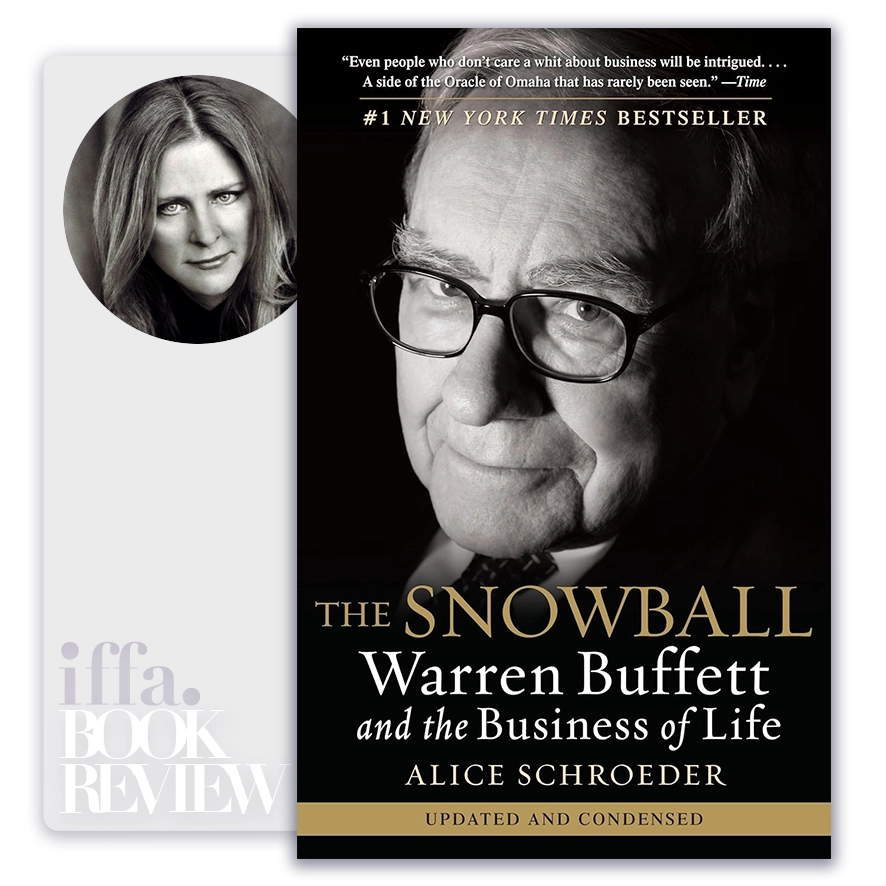
by Alice Schroeder
Summary Overview:
Most books about success focus on tactics—what to do, what to buy, what to copy. The Snowball is fundamentally different. It is not just a biography of one of the most successful investors in history; it is a deep study of how long-term thinking, disciplined judgment, character, and compounding behavior create extraordinary outcomes over decades. This book matters because it shows that enduring success is rarely explosive or glamorous—it is incremental, patient, and relentlessly consistent.
For executives, board members, investors, entrepreneurs, and long-term capital stewards, The Snowball offers lessons that go far beyond investing. Through the life of Warren Buffett, the book reveals how decisions compound not only financially, but reputationally, ethically, and strategically. In an era obsessed with speed, disruption, and short-term wins, The Snowball is a reminder that time, integrity, and focus remain the most powerful forces in business and leadership.
About The Author
Alice Schroeder is a former managing director and senior equity analyst at Morgan Stanley, as well as a seasoned business journalist. Her background in finance gives her rare access and analytical depth, while her journalistic discipline brings narrative clarity and balance.
What makes The Snowball unique is that it is the only authorized biography of Warren Buffett, written with unprecedented access to Buffett’s personal papers, correspondence, family, and inner circle. Schroeder does not write a sanitized success story; she presents a complex, human portrait that explores brilliance, discipline, contradictions, and trade-offs with honesty and nuance.
Core Idea:
At the heart of The Snowball lies a simple but powerful metaphor:
Success is a snowball—it grows through consistent, intelligent decisions made early and allowed to compound over time.
Buffett’s extraordinary wealth and influence did not come from sudden breakthroughs or risky bets. They came from:
- Early obsession with learning
- Extreme patience
- Rational decision-making
- Avoidance of unnecessary risk
- Letting compounding do the heavy lifting
The book shows that Buffett’s real advantage was not secret information or superior forecasting—it was temperament, discipline, and a long-term orientation so rare that it became decisive.
Extraordinary success is not created by dramatic moments, but by thousands of small, rational decisions allowed to compound over time.
Key Concepts:
- Early Formation: Curiosity, Numbers, and Obsession
Schroeder traces Buffett’s mindset back to childhood, revealing that his success was not accidental. From an early age, Buffett displayed:
- An obsession with numbers
- A fascination with probability and odds
- A desire to understand how money works
Rather than treating this as mere precocity, the book shows how early immersion creates lasting advantage. Buffett’s relentless reading, habit of self-education, and willingness to study boring fundamentals gave him a knowledge base that compounded alongside capital.
This reinforces a critical executive lesson: learning compounds just as powerfully as money, but only when pursued consistently over time.
- The Discipline of Value and Rationality
A central theme of The Snowball is Buffett’s unwavering commitment to rational decision-making. Influenced heavily by Benjamin Graham, Buffett learned to:
- Demand a margin of safety
- Separate price from value
- Ignore market noise
- Avoid speculation
Yet Schroeder also shows how Buffett evolved beyond rigid formulas. Over time, he learned that great businesses with durable advantages could justify paying more than strict liquidation value—if the long-term economics were exceptional.
This evolution highlights a subtle but crucial leadership insight: principles should be stable, but application must adapt.
- Temperament as the Ultimate Edge
One of the book’s most powerful revelations is that Buffett’s greatest strength is emotional—not analytical. He is:
- Comfortable being out of step with the crowd
- Resistant to fear and euphoria
- Willing to wait indefinitely for the right opportunity
Schroeder repeatedly emphasizes that many investors understood Buffett’s logic, but few could match his temperament. The ability to do nothing—to wait calmly while others panic or chase trends—proved to be a decisive advantage.
For leaders and boards, this underscores a timeless truth: decision quality deteriorates fastest under emotional pressure.
- Compounding Beyond Capital
While The Snowball is often read as an investing book, it is equally a study of non-financial compounding. Buffett compounds:
- Reputation
- Trust
- Relationships
- Credibility
His emphasis on integrity, simple communication, and long-term partnerships created a network of trust that continuously reinforced his financial success. People wanted to do business with Buffett not just because he was smart—but because he was predictable, fair, and aligned with long-term outcomes.
This highlights a powerful executive lesson: trust compounds faster than capital, and lasts longer.
- Berkshire Hathaway: Structure as Strategy
Schroeder offers deep insight into how Buffett structured Berkshire Hathaway to support his philosophy. Key elements include:
- Extreme decentralization
- Minimal bureaucracy
- Trust-based management
- Long-term ownership mindset
Rather than controlling managers tightly, Buffett selected people carefully and then got out of their way. This structure allowed Berkshire to scale without losing agility or culture.
For modern leaders, this challenges conventional assumptions about control, oversight, and scale. Great systems reduce the need for constant intervention.
- The Cost of Focus and Trade-Offs
One of the book’s most valuable contributions is its honesty about trade-offs. Buffett’s intense focus on investing came at personal cost:
- Emotional distance
- Strained relationships
- Sacrifices in family life
Schroeder does not romanticize these costs. Instead, she presents them as the price of extreme specialization. This nuanced portrayal invites readers to reflect on their own definitions of success and balance.
Leadership, the book suggests, is not about having everything—it is about choosing consciously what you are willing to give up.
- Ethics, Reputation, and Responsibility
As Buffett’s wealth and influence grew, so did his sense of responsibility. The Snowball explores his evolving views on:
- Corporate ethics
- Executive compensation
- Philanthropy
- Social responsibility
Rather than framing ethics as external obligation, Buffett treats them as long-term strategic assets. Reputation, once damaged, destroys compounding; once strengthened, it accelerates it.
This reinforces a critical governance insight: ethical behavior is not separate from performance—it is foundational to it.
- Executive Insights & Strategic Implications
The Snowball reframes success as long-duration excellence, not short-term brilliance. It shows that sustainable advantage emerges from consistency, character, and systems that allow compounding to operate uninterrupted.
Key implications for executives and boards include:
- Time horizon is a strategic choice
- Temperament matters as much as talent
- Simple models outperform complex ones over time
- Trust and reputation are compounding assets
- Structure should reinforce values, not fight them
- Patience is a competitive advantage
Organizations that optimize for speed alone often sacrifice the very forces that create durability.
The greatest competitive advantage in business and investing is not intelligence—it is patience, discipline, and emotional control.
Executive Insights:
The Snowball reframes success as long-duration excellence, not short-term brilliance. It shows that sustainable advantage emerges from consistency, character, and systems that allow compounding to operate uninterrupted.
Key implications for executives and boards include:
- Time horizon is a strategic choice
- Temperament matters as much as talent
- Simple models outperform complex ones over time
- Trust and reputation are compounding assets
- Structure should reinforce values, not fight them
- Patience is a competitive advantage
Organizations that optimize for speed alone often sacrifice the very forces that create durability.
Actionable Takeaways:
For leaders and investors, The Snowball encourages:
- Designing strategies that benefit from time, not timing
- Building cultures that reward patience and rationality
- Reducing complexity to improve decision quality
- Selecting people for integrity and judgment, not just performance
- Measuring success over full cycles, not quarters
Boards are reminded to evaluate leadership not only on results, but on process, temperament, and long-term alignment.
Final Thoughts:
The Snowball is ultimately a book about how lives, businesses, and reputations are built—slowly, deliberately, and cumulatively. Alice Schroeder shows that Warren Buffett’s greatness did not come from secret formulas or extraordinary risk-taking, but from clarity of thought, emotional discipline, and respect for compounding in all its forms.
In a world that rewards speed and spectacle, this book delivers a quieter but far more powerful lesson:
Let time work for you, not against you.
Protect the downside.
Act rationally.
And allow compounding—financial and human—to do its work.
That, more than any tactic, is the true legacy of The Snowball.
The ideas in this book go beyond theory, offering practical insights that shape real careers, leadership paths, and professional decisions. At IFFA, these principles are translated into executive courses, professional certifications, and curated learning events aligned with today’s industries and tomorrow’s demands. Discover more in our Courses.
Applied Programs

- Course Code : SBM-409
- Delivery : In-class / Virtual / Workshop
- Duration : 2-4 Days
- Venue: DUBAI HUB

- Course Code : PMA-613
- Delivery : In-class / Virtual / Workshop
- Duration : 3-5 Days
- Venue: DUBAI HUB
- Course Code : CIF-505
- Delivery : In-class / Virtual / Workshop
- Duration : 3-5 Days
- Venue: DUBAI HUB

- Course Code : CIF-512
- Delivery : In-class / Virtual / Workshop
- Duration : 2-4 Days
- Venue: DUBAI HUB
Related Books