
The Executive Summary of
The Law of the Sea
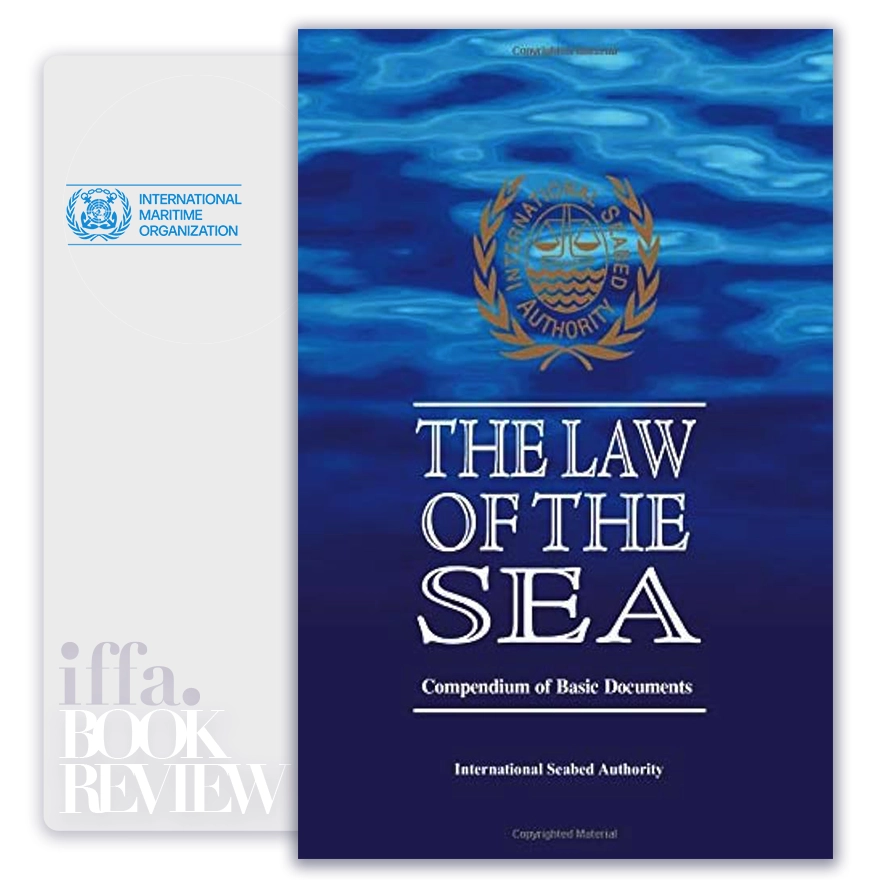
by United Nations
Summary Overview:
The Law of the Sea: Compendium of Basic Documents matters because it constitutes the foundational legal framework governing nearly three-quarters of the planet. Oceans are not empty spaces between nations; they are zones of sovereignty, commerce, security, environmental stewardship, and geopolitical tension. The compendium brings together the core legal instruments that define how states interact with one another at sea—and how power, rights, and responsibilities are allocated beyond land borders.
In an era of intensifying maritime disputes, offshore resource competition, undersea infrastructure expansion, and environmental stress, the law of the sea has moved from a specialist concern to a strategic imperative. Shipping routes underpin global trade, seabeds hold critical minerals and energy resources, and maritime boundaries increasingly intersect with national security and climate adaptation. This collection clarifies the legal order that makes cooperation possible—and conflict containable.
For governments, naval authorities, shipping leaders, energy developers, insurers, and international institutions, this compendium functions not as abstract law, but as operational governance. It defines what states may do, must do, and must refrain from doing. Understanding these documents is essential for long-term planning, risk management, and legitimacy in maritime affairs.
About The Institution
The United Nations serves as the primary international forum for negotiating, codifying, and maintaining the legal order of the seas. Through decades of multilateral engagement, it has shaped a rules-based maritime system designed to balance sovereignty, freedom of navigation, resource use, and environmental protection.
Core Idea:
The core idea of The Law of the Sea: Compendium of Basic Documents is that the oceans are governed by a comprehensive, interlocking legal system that replaces power-based claims with rules-based order. Rather than allowing unrestricted competition or unilateral control, the law of the sea establishes shared norms that regulate access, jurisdiction, and responsibility across maritime spaces.
At the heart of this framework is the recognition that oceans are both divisible and shared. Coastal states enjoy defined sovereign rights, while vast areas remain under collective regimes such as the high seas and the international seabed. The compendium demonstrates how modern maritime law seeks to reconcile national interest with global stability, economic use with environmental protection, and freedom with accountability.
The law of the sea transforms oceans from contested frontiers into governed spaces.
Key Concepts:
- Maritime Zones and Jurisdiction
The compendium defines distinct maritime zones—territorial seas, contiguous zones, exclusive economic zones (EEZs), and continental shelves—each with specific rights and obligations. These distinctions are central to sovereignty, enforcement, and resource access. - Sovereignty Balanced by International Obligation
While coastal states exercise authority in adjacent waters, their rights are limited by duties toward other states. Innocent passage, transit passage, and freedom of navigation ensure global mobility while preserving national control. - Exclusive Economic Zones as Strategic Space
EEZs grant coastal states sovereign rights over natural resources up to 200 nautical miles. This regime has reshaped global geopolitics, energy strategy, fisheries management, and maritime enforcement. - The Continental Shelf and Seabed Rights
The law recognizes states’ rights over seabed resources beyond EEZs in certain cases. These provisions underpin offshore hydrocarbons, deep-sea mining, and long-term resource planning. - The High Seas as a Global Commons
Areas beyond national jurisdiction are governed by principles of freedom and collective responsibility. The compendium underscores that no state may claim sovereignty over the high seas. - The International Seabed Area (“the Area”)
Resources of the deep seabed beyond national jurisdiction are designated as the common heritage of mankind. The documents establish mechanisms for shared benefit and international administration. - Environmental Protection and Marine Pollution
States are obligated to prevent, reduce, and control marine pollution from ships, land-based sources, and offshore activities. Environmental stewardship is treated as a legal duty, not voluntary action. - Marine Scientific Research
The framework balances the freedom to conduct scientific research with coastal state consent and data-sharing obligations, recognizing science as both a sovereign and collective interest. - Dispute Resolution Mechanisms
The law of the sea provides structured methods for resolving disputes through courts, tribunals, arbitration, and negotiation—reducing reliance on coercion or force. - Peaceful Use and Security at Sea
The compendium reinforces that oceans should be used for peaceful purposes. Even military activities are constrained by international norms designed to prevent escalation and preserve stability.
Maritime stability depends not on naval power alone, but on shared legal commitments.
Executive Insights:
The compendium reveals that maritime order is not accidental—it is constructed through law, maintained through compliance, and tested through pressure. When states respect the law of the sea, trade flows, disputes remain manageable, and investment risk declines. When it is ignored or selectively applied, instability spreads rapidly across regions.
For executives and policymakers, the documents clarify that maritime operations—shipping, offshore energy, fisheries, cables, ports—are inseparable from legal legitimacy. Strategic advantage increasingly depends on legal positioning as much as physical capability.
The compendium also underscores a critical long-term reality: as climate change reshapes coastlines, sea levels, and resource access, the law of the sea will become even more central to managing transition without conflict.
Key strategic implications include:
- Maritime law underpins global trade and energy security
- Legal clarity reduces geopolitical and commercial risk
- EEZs redefine economic sovereignty at sea
- Environmental duties are enforceable obligations
- Dispute resolution mechanisms preserve stability
Actionable Takeaways:
The compendium offers foundational principles relevant across maritime sectors.
- Treat maritime law as strategic infrastructure, not legal formality
- Align national and corporate activities with established maritime zones
- Integrate environmental obligations into operational planning
- Use legal mechanisms proactively to manage disputes
- Recognize oceans as shared systems requiring cooperation
- Anticipate climate-driven legal and boundary challenges
- Build institutional literacy in the law of the sea
Final Thoughts:
The Law of the Sea: Compendium of Basic Documents represents one of humanity’s most ambitious efforts to govern a shared domain through law rather than force. Its quiet achievement lies in replacing chaos with structure across the world’s oceans.
The enduring insight of the compendium is clear and consequential: the stability of the seas depends not on dominance, but on adherence to common rules. Leaders who understand and respect this framework contribute not only to their own strategic interests, but to the preservation of a global order in which oceans remain connectors rather than fault lines.
The ideas in this book go beyond theory, offering practical insights that shape real careers, leadership paths, and professional decisions. At IFFA, these principles are translated into executive courses, professional certifications, and curated learning events aligned with today’s industries and tomorrow’s demands. Discover more in our Courses.
Applied Programs

- Course Code : SBM-409
- Delivery : In-class / Virtual / Workshop
- Duration : 2-4 Days
- Venue: DUBAI HUB

- Course Code : PMA-613
- Delivery : In-class / Virtual / Workshop
- Duration : 3-5 Days
- Venue: DUBAI HUB
- Course Code : CIF-505
- Delivery : In-class / Virtual / Workshop
- Duration : 3-5 Days
- Venue: DUBAI HUB

- Course Code : CIF-512
- Delivery : In-class / Virtual / Workshop
- Duration : 2-4 Days
- Venue: DUBAI HUB
Related Books