
The Executive Summary of
The New Urban Crisis
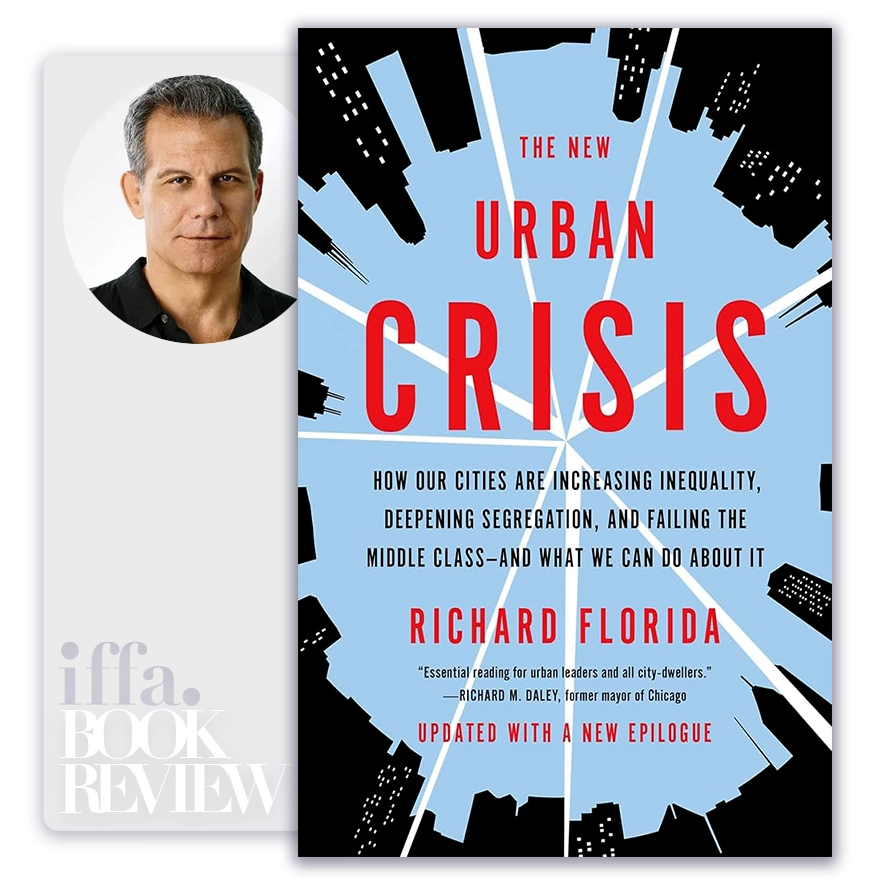
by Richard Florida
Summary Overview:
The Language of Architecture matters because it reframes architecture not as a collection of styles or technical solutions, but as a language through which ideas, values, and intentions are communicated. In an era where buildings are often judged by performance metrics, images, or market appeal, Simitch and Warke return attention to a deeper question: what does architecture say, and how does it say it?
The book is especially relevant for leaders, designers, and decision-makers involved in shaping the built environment—cities, campuses, institutions, and public spaces—where architecture must carry meaning across time. Buildings outlive strategies, leadership teams, and political cycles. Their forms, proportions, and spatial decisions continue to communicate long after original intentions are forgotten. Understanding architectural language therefore becomes a matter of long-term judgment and responsibility, not aesthetic preference.
Rather than prescribing a design method, the authors offer a way to read and interpret architecture critically. They show how architects use form, geometry, structure, and spatial relationships as a vocabulary—one that can be learned, analyzed, and applied deliberately. For those engaged in governance, planning, or large-scale development, the book provides a framework for asking better questions about design quality, coherence, and meaning beyond surface appearance.
About The Author
Richard Florida is a leading urban theorist known for his work on cities, innovation, and the geography of economic development. His perspective is distinctive for combining data-driven analysis with social critique, examining how structural forces shape where opportunity concentrates—and where it disappears.
Core Idea:
The core idea of The New Urban Crisis is that modern capitalism has become spatially concentrated, producing a small number of “winner” cities that attract disproportionate shares of talent, investment, and innovation—while leaving other cities and regions behind. This concentration fuels growth but also intensifies inequality within and between places.
Florida argues that cities are no longer simply sites of opportunity; they are sorting mechanisms. High-skilled workers cluster in expensive urban cores, while lower-income populations are displaced to peripheries with fewer services, weaker job access, and declining infrastructure. The crisis is not urban decline, but urban success without inclusion.
The crisis of our cities is not caused by failure, but by success that benefits too few.
Key Concepts:
- The Rise of Superstar Cities
A small group of global cities dominate innovation, finance, and cultural production. These cities attract talent and capital at accelerating rates, reinforcing their advantage while driving up costs and barriers to entry. - Spatial Inequality as a Structural Feature
Inequality is no longer only about income; it is about where people live. Access to opportunity, education, healthcare, and networks is increasingly determined by geography. - The Housing Affordability Trap
Housing shortages and speculative investment push prices far beyond what middle- and working-class residents can afford. This creates displacement, longer commutes, and social fragmentation—even in prosperous cities. - The Service Class Squeeze
Cities depend on service workers—teachers, nurses, transit staff, hospitality workers—but often price them out. Florida highlights how this mismatch threatens urban functionality and social cohesion. - Urban Segregation by Income and Class
Modern cities are increasingly segregated not just by race, but by income and education. This segregation limits mobility, reinforces inequality, and undermines civic life. - Decline of the Middle Neighborhood
The book documents the erosion of middle-income urban neighborhoods, which once acted as stabilizing forces. Their disappearance creates polarized landscapes of wealth and poverty. - The Geography of Opportunity
Economic mobility depends heavily on neighborhood conditions—schools, safety, transportation, and social networks. Place-based inequality reproduces itself across generations. - Transportation and Commuting Burdens
As people are pushed farther from city centers, commuting times and costs rise. This erodes quality of life and productivity while deepening environmental and social stress. - The Limits of Market-Driven Urbanism
Florida critiques the assumption that markets alone can solve urban problems. Left unchecked, market dynamics amplify inequality and misallocate resources, especially in housing and land use. - The Need for a New Urban Social Compact
The book calls for rethinking how cities distribute opportunity, invest in infrastructure, and govern growth—moving toward inclusive models that balance prosperity with equity.
Economic inequality is now deeply embedded in geography.
Executive Insights:
The New Urban Crisis reframes urban inequality as a systemic economic risk, not merely a social issue. Cities that fail to address affordability, access, and inclusion risk talent loss, social unrest, and declining competitiveness over time.
For leaders, the book underscores that place matters more than ever. Corporate location decisions, infrastructure investment, housing policy, and workforce strategy all intersect with urban inequality. Ignoring these dynamics exposes organizations and governments to long-term instability.
The book also challenges simplistic narratives about urban revival. Growth without governance creates fragility. Sustainable cities require intentional design, coordinated policy, and long-term thinking.
Key strategic implications include:
- Urban inequality undermines long-term economic resilience
- Housing affordability is a strategic, not peripheral, issue
- Geographic concentration increases systemic risk
- Inclusive growth strengthens cities’ competitive advantage
- Governance quality determines whether prosperity endures
Actionable Takeaways:
The book translates into broad, practical principles for urban decision-making.
- Treat housing affordability as core infrastructure
- Invest in transportation that connects people to opportunity
- Support mixed-income neighborhoods to reduce segregation
- Align economic development with inclusion goals
- Recognize service workers as essential to urban success
- Balance market forces with public policy and regulation
- Adopt place-based strategies to expand opportunity
Final Thoughts:
The New Urban Crisis is ultimately a book about the unintended consequences of success. Richard Florida shows that cities have become central to modern prosperity—but without deliberate action, they risk becoming engines of exclusion rather than opportunity.
The enduring insight of the book is clear: the future of cities depends not on how fast they grow, but on who gets to belong. Leaders who understand this will move beyond celebrating urban success to governing it wisely—ensuring that cities remain not just productive, but livable, inclusive, and resilient for generations to come.
The ideas in this book go beyond theory, offering practical insights that shape real careers, leadership paths, and professional decisions. At IFFA, these principles are translated into executive courses, professional certifications, and curated learning events aligned with today’s industries and tomorrow’s demands. Discover more in our Courses.
Applied Programs

- Course Code : SBM-409
- Delivery : In-class / Virtual / Workshop
- Duration : 2-4 Days
- Venue: DUBAI HUB

- Course Code : PMA-613
- Delivery : In-class / Virtual / Workshop
- Duration : 3-5 Days
- Venue: DUBAI HUB
- Course Code : CIF-505
- Delivery : In-class / Virtual / Workshop
- Duration : 3-5 Days
- Venue: DUBAI HUB

- Course Code : CIF-512
- Delivery : In-class / Virtual / Workshop
- Duration : 2-4 Days
- Venue: DUBAI HUB
Related Books