
The Executive Summary of
Design Thinking
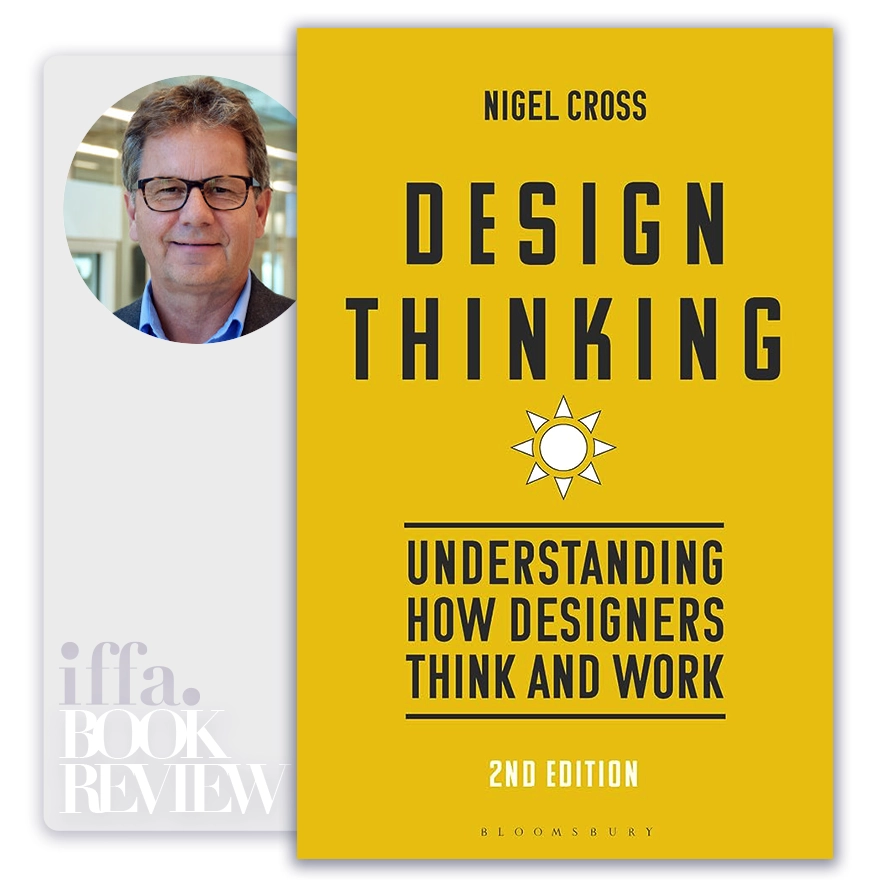
by Nigel Cross
Summary Overview:
Design Thinking matters because it challenges a long-standing assumption in management, engineering, and policy: that complex problems are best solved through linear analysis alone. Nigel Cross demonstrates that designers approach problems differently—not because they are less rigorous, but because they operate in environments where uncertainty, ambiguity, and competing constraints are unavoidable.
In a world defined by rapid change, interconnected systems, and problems with no single “correct” answer—climate transition, digital transformation, urbanization, organizational design—traditional problem-solving models often fall short. Cross’s work explains why design thinking has emerged as a valuable complement to analytical reasoning: it provides a way to act intelligently when requirements are incomplete and outcomes cannot be fully predicted.
For leaders, strategists, and decision-makers, the relevance of this book lies in its depth. Unlike popularized versions of design thinking that focus on workshops or tools, Cross examines the cognitive foundations of how designers think. This makes the book especially useful for those interested in judgment, decision quality, and innovation under real-world constraints—where clarity must be constructed, not discovered.
About The Author
Nigel Cross is one of the foundational scholars in design research, known for establishing design thinking as a legitimate field of intellectual inquiry. His work is distinctive for rigorously studying how expert designers reason, decide, and create, positioning design as a discipline with its own forms of knowledge and logic.
Core Idea:
The core idea of Design Thinking is that design represents a distinct mode of thinking, different from scientific analysis or artistic expression. Designers do not merely apply knowledge; they generate possibilities, frame problems, and iterate toward solutions in situations where goals, constraints, and success criteria evolve over time.
Cross argues that design thinking operates through constructive reasoning. Rather than optimizing within fixed parameters, designers co-evolve problems and solutions together. This approach is particularly effective in complex systems where defining the problem is itself part of the challenge. Design thinking, therefore, is not about aesthetics—it is about making informed decisions in uncertainty.
Design thinking excels where problems are ill-defined and solutions must be created, not discovered.
Key Concepts:
- Design as a Third Culture of Knowledge
Cross positions design alongside science and the humanities as a distinct “culture” of knowledge. While science explains how the world is, and humanities explore meaning, design focuses on how the world could be. This forward-looking orientation makes it uniquely valuable for innovation and strategy. - Ill-Defined Problems Are the Norm, Not the Exception
Design problems rarely have complete information or stable requirements. Cross shows that expert designers accept ambiguity and use it productively, rather than waiting for perfect clarity. This insight is critical for leaders facing evolving conditions. - Problem Framing Is a Strategic Act
Designers do not passively accept problem statements; they actively reframe them. How a problem is defined determines which solutions are visible. Strategic advantage often comes from reframing challenges, not from executing faster within flawed frames. - Solution-Focused Reasoning
Rather than exhaustively analyzing problems upfront, designers explore potential solutions early. These tentative solutions act as probes, revealing constraints and opportunities that analysis alone might miss. - Co-Evolution of Problems and Solutions
Cross highlights that understanding deepens as solutions are proposed and tested. Problems and solutions evolve together. This contrasts with linear planning models and explains why rigid upfront specifications often fail. - Use of Abductive Reasoning
Design thinking relies heavily on abductive reasoning—inferring what might be true or possible. This form of logic enables creative leaps while remaining grounded in constraints, making it essential for innovation. - Sketching and Externalization of Thought
Designers externalize thinking through sketches, models, and diagrams. These artifacts are not presentations; they are thinking tools that support iteration, dialogue, and shared understanding. - Constraints as Enablers, Not Obstacles
Constraints—budget, materials, regulations—do not limit creativity; they shape it. Cross shows how expert designers leverage constraints to focus effort and improve decision quality. - Expertise Built Through Reflection and Practice
Design expertise develops through experience, reflection, and pattern recognition. It is less about following rules and more about judgment honed over time, which has implications for leadership development. - Transferability Beyond Design Professions
Although rooted in architecture, engineering, and industrial design, Cross argues that design thinking applies to management, policy, and organizational leadership—anywhere problems are complex and goals are evolving.
The power of design lies in its ability to frame problems as well as solve them.
Executive Insights:
Design Thinking reframes decision-making as an active, constructive process, not a purely analytical one. Its insights suggest that many strategic failures arise not from poor execution, but from inadequate problem framing and overreliance on linear logic in non-linear environments.
For leaders, the book underscores the importance of tolerating ambiguity while maintaining direction. Organizations that insist on certainty before acting often fall behind those willing to explore, test, and learn. Design thinking provides a disciplined way to do this without descending into chaos.
Key strategic implications include:
- Complex challenges require constructive, not purely analytical, reasoning
- Strategic advantage often comes from reframing problems
- Early solution exploration improves understanding
- Constraints improve focus and decision quality
- Judgment and learning matter more than rigid plans
Actionable Takeaways:
The book translates into practical, general principles for leadership and strategy.
- Accept ambiguity as a starting condition, not a failure
- Reframe problems deliberately before committing to solutions
- Explore multiple solution paths early to reveal insights
- Externalize thinking to improve collaboration and learning
- Treat constraints as design inputs rather than limitations
- Build decision capability through reflection and iteration
- Apply design logic to strategy, policy, and organizational challenges
Final Thoughts:
Design Thinking is not a manual for creativity workshops or innovation slogans. It is a serious examination of how humans make intelligent decisions in uncertain conditions. Nigel Cross shows that design thinking is neither intuition nor improvisation—it is a disciplined way of reasoning when problems resist clear definition.
The enduring insight of the book is clear: when the future cannot be predicted, it must be designed. Leaders who understand and apply design thinking do not wait for perfect information; they shape direction through exploration, judgment, and learning. In a complex world, this capability is no longer optional—it is foundational.
The ideas in this book go beyond theory, offering practical insights that shape real careers, leadership paths, and professional decisions. At IFFA, these principles are translated into executive courses, professional certifications, and curated learning events aligned with today’s industries and tomorrow’s demands. Discover more in our Courses.
Applied Programs

- Course Code : SBM-409
- Delivery : In-class / Virtual / Workshop
- Duration : 2-4 Days
- Venue: DUBAI HUB

- Course Code : PMA-613
- Delivery : In-class / Virtual / Workshop
- Duration : 3-5 Days
- Venue: DUBAI HUB
- Course Code : CIF-505
- Delivery : In-class / Virtual / Workshop
- Duration : 3-5 Days
- Venue: DUBAI HUB

- Course Code : CIF-512
- Delivery : In-class / Virtual / Workshop
- Duration : 2-4 Days
- Venue: DUBAI HUB
Related Books